B

2000006507

Level: 
B
The bases of the prism shown in the figure are regular hexagons \(ABCDEF\) and \(A'B'C'D'E'F'\). The lateral edges are perpendicular to the bases. Let \(\pi\) be a plane through the points \(B\), \(D\), \(D'\), \(B'\) (see the picture). How many diagonals of the prism are perpendicular to the plane \(\pi\)?
\(2\)
\(4\)
\(3\)
\(1\)

2000006304

Level: 
B
An inequality is solved graphically as shown in the picture. The solution is marked in red. Choose the corresponding inequality.
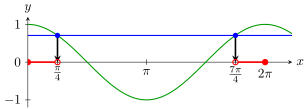
\[ \cos{x} > \frac{\sqrt{2}}{2} \] \[ x \in [ 0;2\pi ]\]
\[ \cos{x} > \frac{\sqrt{3}}{2} \] \[ x \in [ 0;2\pi ]\]
\[ \cos{x} \geq \frac{\sqrt{2}}{2} \] \[ x \in [ 0;2\pi ]\]
\[ \cos{x} \geq \frac{\sqrt{3}}{2} \] \[ x \in [ 0;2\pi ]\]

2000006303

Level: 
B
An inequality is solved graphically as shown in the picture. The solution is marked in red. Choose the corresponding inequality.
\[ \cos{x} < \frac{1}{2} \] \[ x \in [ 0;2\pi ]\]
\[ \cos{x} \leq \frac{\sqrt{2}}{2} \] \[ x \in [ 0;2\pi ]\]
\[ \cos{x} < \frac{\sqrt{2}}{2} \] \[ x \in [ 0;2\pi ]\]
\[ \cos{x} \leq \frac{1}{2} \] \[ x \in [ 0;2\pi ]\]

2000006302

Level: 
B
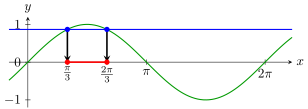
An inequality is solved graphically as shown in the picture. The solution is marked in red. Choose the corresponding inequality.
\[ \sin{x} < \frac{1}{2} \] \[ x \in [ 0;2\pi ]\]
\[ \sin{x} \leq \frac{\sqrt{2}}{2} \] \[ x \in [ 0;2\pi ]\]
\[ \sin{x} < \frac{\sqrt{2}}{2} \] \[ x \in [ 0;2\pi ]\]
\[ \sin{x} \leq \frac{1}{2} \] \[ x \in [ 0;2\pi ]\]

2000006301

Level: 
B
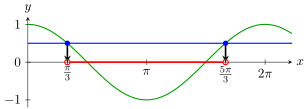
An inequality is solved graphically as shown in the picture. The solution is marked in red. Choose the corresponding inequality.
\[ \sin{x} \geq \frac{\sqrt{3}}{2} \] \[ x \in [ 0;2\pi ]\]
\[ \sin{x} \geq \frac{\sqrt{2}}{2} \] \[ x \in [ 0;2\pi ]\]
\[ \sin{x} > \frac{\sqrt{3}}{2} \] \[ x \in [ 0;2\pi ]\]
\[ \sin{x} > \frac{\sqrt{2}}{2} \] \[ x \in [ 0;2\pi ]\]

2000006006

Level: 
B
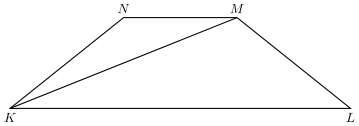
The bases of the trapezoid \(KLMN\) are \(12\,\mathrm{cm}\) and \(4\,\mathrm{cm}\) long. The area of the triangle \(KMN\) is \(9\,\mathrm{cm}^2\). What is the area of the trapezoid \(KLMN\)?
\(36\,\mathrm{cm}^2\)
\(72\,\mathrm{cm}^2\)
\(18\,\mathrm{cm}^2\)
\(40\,\mathrm{cm}^2\)