A basketball player throws a free throw with a \(0.9\) probability of success. What is the probability that he/she will make at least one of the three free throws?
A basketball player throws a free throw with a \(0.5\) probability of success. What is the probability that he/she will make all of the three free throws?
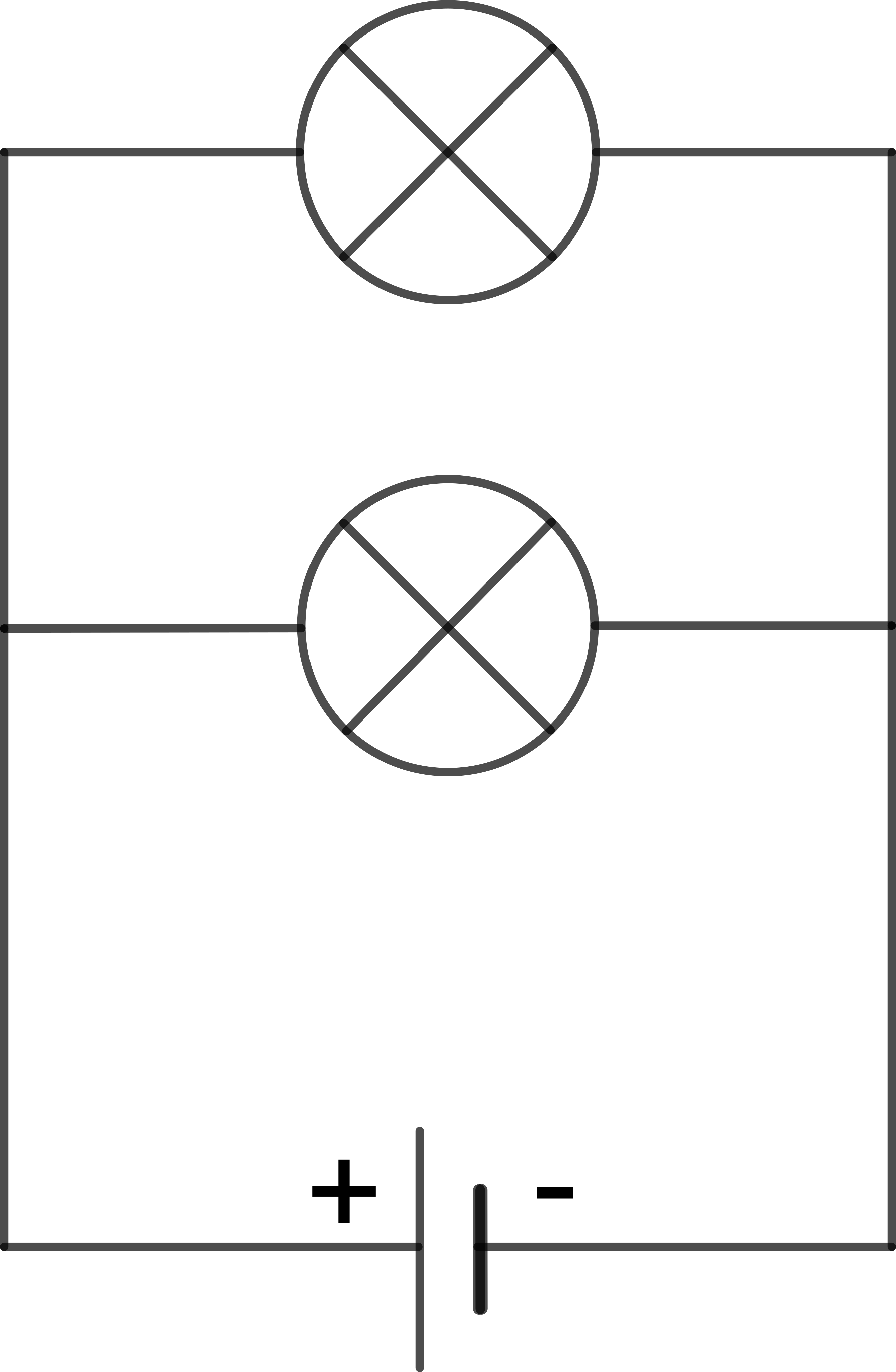
Two identical light bulbs are connected to the battery as shown in the electrical circuit diagram.
The reliability of each of the bulbs is \(0.5\). What is the probability that the current flows through the circuit, i.e., at least one bulb is glowing? (Note: Reliability is the probability that the component will perform its intended function.)
Two identical light bulbs are connected to the battery as shown in the electrical circuit diagram.
The reliability of each of the bulbs is \(0.4\). What is the probability that the current flows through the circuit, i.e., both bulbs are glowing? (Note: Reliability is the probability that the component will perform its intended function.)
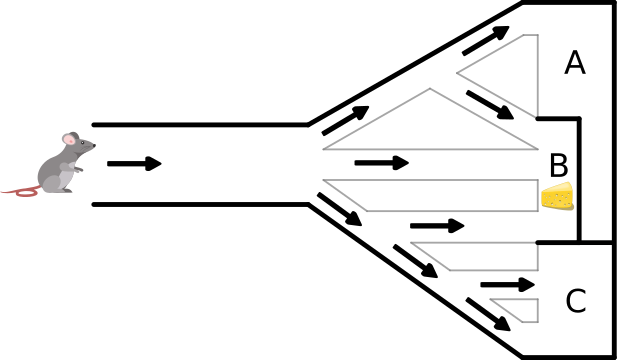
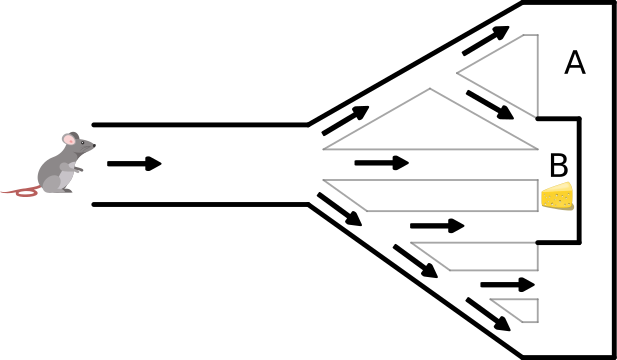
Peter built a maze for his pet mouse Mickey (see the floor plan in the picture). In addition, he placed some cheese in an airtight container in room B. Suppose that every time Mickey reaches a split in the maze, he is equally likely to choose any of the paths in front of him. Which of the following statements is true?
The probability that Mickey will end up in room A or C is the same.
The probability that Mickey will end up in room C is greater than for room A.
The probability that Mickey will end up in room B is the same as in case of rooms A and C.
Peter built a maze for his pet mouse Mickey (see the floor plan in the picture). In addition, he placed some cheese in an airtight container in room B. Suppose that every time Mickey reaches a split in the maze, he is equally likely to choose any of the paths in front of him. What is the probability of Mickey ending up in room B with cheese?
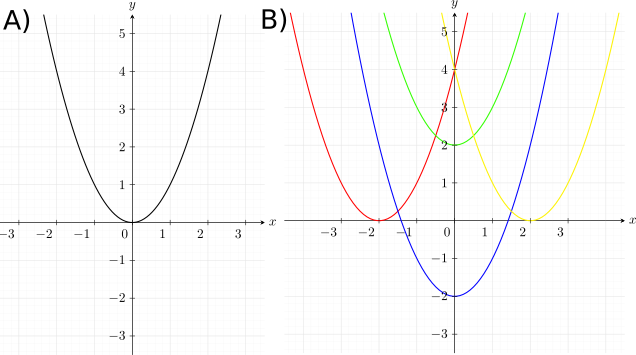
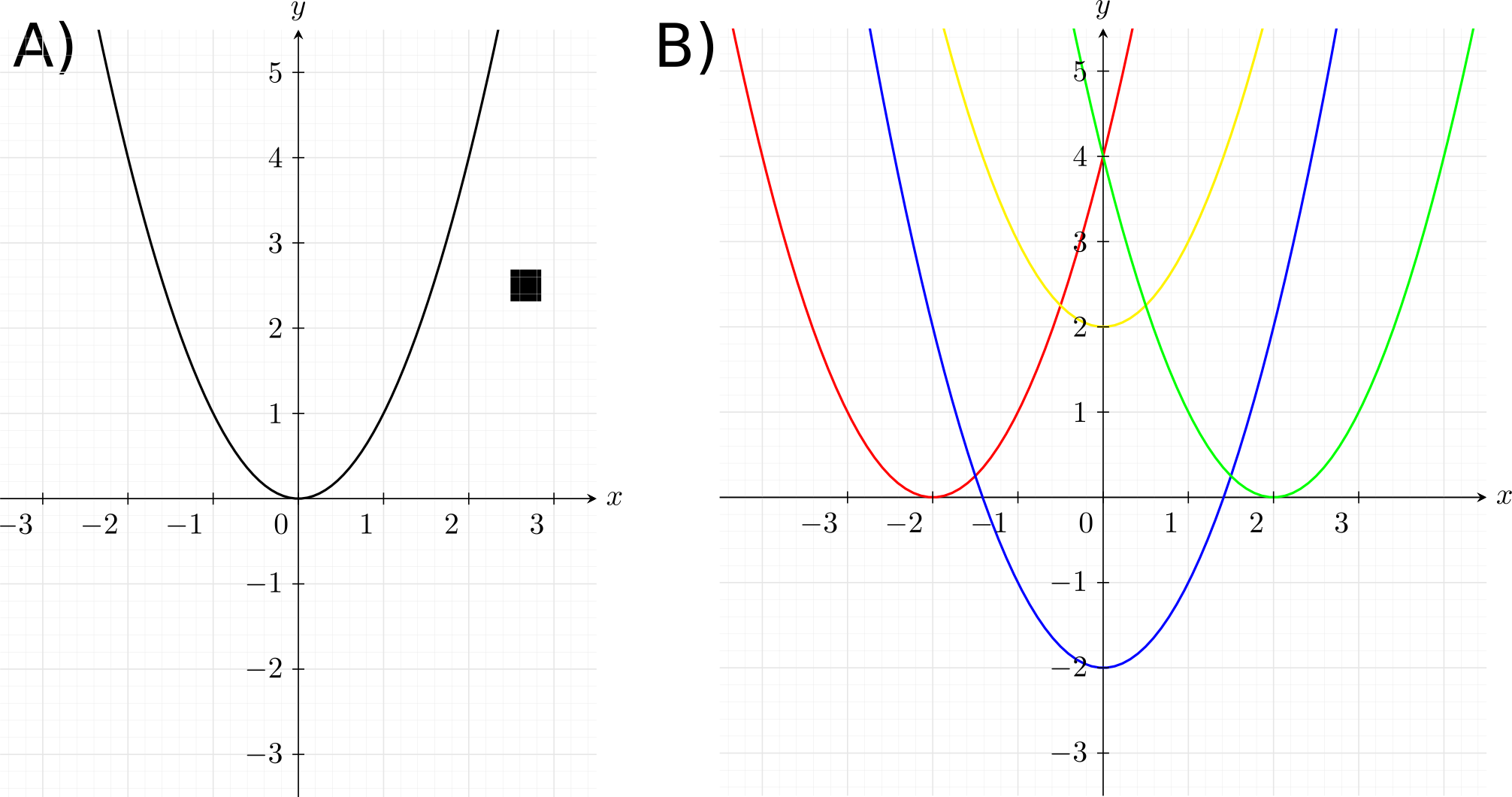
In the picture A, the graph of the quadratic function \( f(x) = x^2\) is shown. With the aid of the graph of \(f\) identify which of the graphs shown in the picture B is the graph of \( g(x) = x^2-2x-3=(x+1)(x-3)\). What is the color of the graph of \(g\)? (Note: Each graph in the picture B was obtained by shifting the graph of \(f\).)
In the picture A, the graph of the quadratic function \( f(x) = x^2\) is shown. With the aid of the graph of \(f\) identify which of the graphs shown in the picture B is the graph of \( g(x) = (x-2)^2\). What is the color of the graph of \(g\)? (Note: Each graph in the picture B is the graph of some transformation of \(f\).)
In the picture A, the graph of the quadratic function \( f(x) = x^2\) is shown. With the aid of the graph of \(f\) identify which of the graphs shown in the picture B is the graph of \( g(x) = (x+2)^2\). What is the color of the graph of \(g\)? (Note: Each graph in the picture B was obtained by shifting the graph of \(f\).)