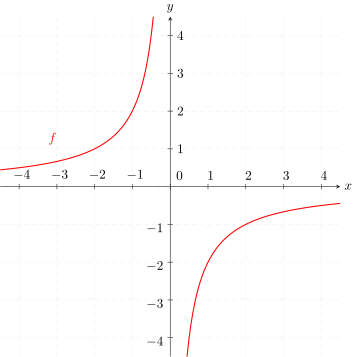
Let \(X\) and
\(Y \) be intersections of the
graph of the function \(f(x) = \frac{3x-5}
{2+x}\)
with \(x\)-
and \(y\)-axis,
respectively. Find these points.
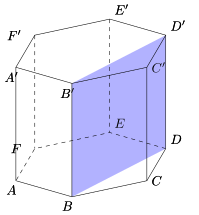
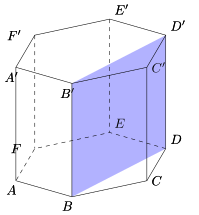
The bases of the prism shown in the figure are regular hexagons \(ABCDEF\) and \(A'B'C'D'E'F'\). The side edges are perpendicular to the bases. Let \(k\) be a line through the points \(A\) and \(C\) (see the picture). How many diagonals of the prism are parallel to the line \(k\)?
The bases of the prism shown in the figure are regular hexagons \(ABCDEF\) and \(A'B'C'D'E'F'\). The lateral edges are perpendicular to the bases. Let \(k\) be a line through the points \(A\) and \(C\) (see the picture). How many lateral faces of the prism are perpendicular to the line \(k\)?
The bases of the prism shown in the figure are regular hexagons \(ABCDEF\) and \(A'B'C'D'E'F'\). The lateral edges are perpendicular to the bases. Let \(\pi\) be a plane through the points \(B\), \(D\), \(D'\), \(B'\) (see the picture). How many lateral faces of the prism are perpendicular to the plane \(\pi\)?