
B

2000019003

Level: 
B
Consider a linear system of three equations with three unknowns \(x\), \(y\), \(z\), and with the column of the right sides: \[ \left (\array{ 5\cr 17\cr 12} \right ) \] The determinants of the following two matrices were used to solve the system by Cramer's rule: \[ \left (\array{ 2& 5& 1\cr 1& 17& -3\cr 1& 12& -2} \right ),~ \left (\array{ 2& -1& 5\cr 1& 2& 17\cr 1& 1& 12} \right ) \] Which of the following systems could be solved in a specified way?
\[\begin{aligned} 2x- y +z= 5 & & \\x +2y-3 z = 17 & & \\x + y -2z= 12 & & \end{aligned}\]
\[\begin{aligned} 2x+5 y +z= -1 & & \\x +17y-3 z = 2& & \\x +12 y -2z= 1 & & \end{aligned}\]
\[\begin{aligned} 2x- y +z= -5 & & \\x +2y-3 z = -17 & & \\ x+y -2z= -12& & \end{aligned}\]
\[\begin{aligned} 2x+ y-z = 5 & & \\x-2y + 3z = 17 & & \\x - y +2z= 12 & & \end{aligned}\]
2000019002

Level: 
B
The system of equations is given by: \[\begin{aligned} x- y = -3 & & \\2x + z = -5 & & \\x + y -z= 0 & & \end{aligned}\] When solving the system using Cramer's rule, we evaluate determinants of four matrices. Suppose we order them according to their values. What is the largest value of these determinants?
\(8\)
\(4\)
\(-4\)
\(12\)

2000019001

Level: 
B
Four matrices are given: \[\] $\left (\array{ 1& -1& 0\cr 2& 0& 1\cr 1& 1& -1} \right ),$ $\left (\array{ 1& -3& 0\cr 2& -5& 1\cr 1& 0& -1} \right ),$ $\left (\array{ -3& -1& 0\cr -5& 0& 1\cr 0& 1& -1} \right ),$ $\left (\array{ 1& -1& -3\cr 2& 0& -5\cr 1& 1& 0} \right )$ \[\] We want to practice Cramer's rule for solving a system of linear equations. Which of the following systems can be solved using determinants of the four matrices given above?
\[\begin{aligned} x- y = -3 & & \\2x + z = -5 & & \\x + y -z= 0 & & \end{aligned}\]
\[\begin{aligned} x- y-3z = 0 & & \\2x - 5z = 1 & & \\x + y = -1& & \end{aligned}\]
\[\begin{aligned} -3x- y = 0 & & \\-5x + z = 1 & & \\ y -z= -1& & \end{aligned}\]
\[\begin{aligned} x- y = 3 & & \\2x + z = 5 & & \\x + y -z= 0 & & \end{aligned}\]

2000018906

Level: 
B
Specify how the rank of the matrix \(A\) changes depending on the value of \(t\), where \[ A=\left (\array{ 3& -2& 1&-4\cr -6& 4& -2&8\cr 0& t& 0&t} \right ). \]
If \(t=0\), the rank is \(1\), otherwise the rank is \(2\).
If \(t=0\), the rank is \(1\), otherwise the rank is \(3\).
If \(t=0\), the rank is \(2\), otherwise the rank is \(1\).
If \(t=2\), the rank is \(3\), otherwise the rank is \(1\).

2000018703

Level: 
B
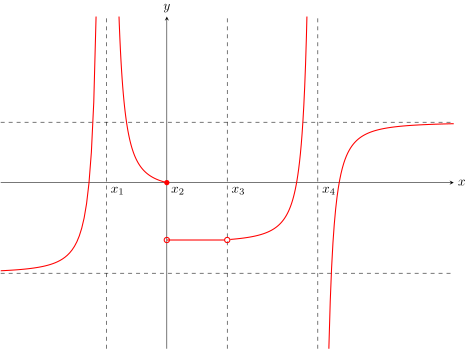
The picture shows a graph of a function. Decide at which of the marked points \(x_1\), \(x_2\), \(x_3\) and \(x_4\), the left-hand and right-hand limit of the function has the same value. (Note: The dashed lines are asymptotes of the function.)
Only at \(x_1\) and \(x_3\).
Only at \(x_1\).
Only at \(x_3\).
The left-hand and right-hand limit is the same at any marked point.