B

2000018702

Level: 
B
Choose the true statement about the limits of the function whose graph is shown in the picture. (Note: The dashed lines are asymptotes of the function.)
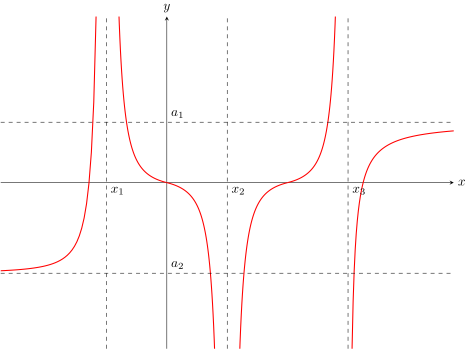
The function has the limit "negative infinity" only at \(x_2\) and at "negative infinity" it has the limit \(a_2\).
The function has the limit "negative infinity" at \(x_2\) and \(x_3\) and at "negative infinity" it has the limit \(a_2\).
The function has the limit "negative infinity" only at \(x_2\) and at "negative infinity" there is no limit.
The function has the limit "negative infinity" at \(x_2\) and \(x_3\) and at "negative infinity" there is no limit.
2000018701

Level: 
B
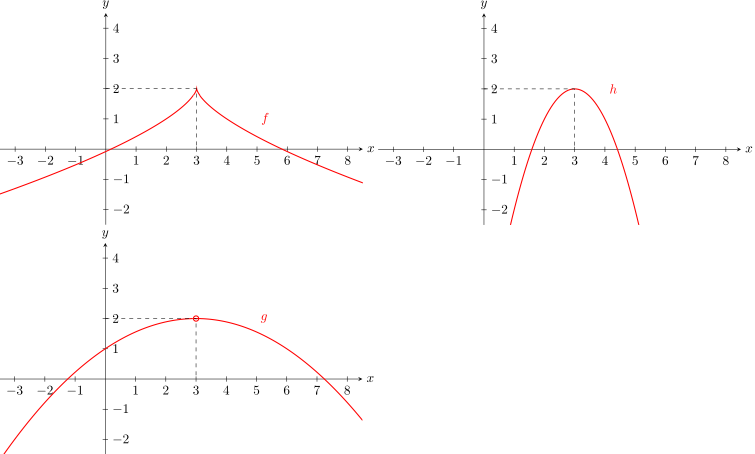
The following pictures show graphs of \(3\) functions. Choose the true statement about the limit at \(x = 3\).
The functions \(f\), \(g\), \(h\) have the same limit at \(x = 3\).
The function \(g\) has no limit at \(x = 3\).
The function \(f\) has no limit at \(x = 3\).
The limits of functions \(f\), \(g\), \(h\) at \(x = 3\) differ.
Only the function \(h\) has a limit at \(x = 3\).

2010018503

Level: 
B
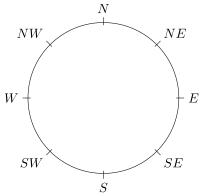
The figure shows a directional rosette that can be used to determine a marching angle. (The initial arm always faces north, and the terminal arm determines the direction of the march, so the measure of the angle increases from north to east.) Give the degree measure of the marching angle if the march is directed southeast.
\( 135^{\circ} \)
\(225^{\circ} \)
\(-135^{\circ} \)
\( 45^{\circ} \)

2000018304

Level: 
B
Which matrices X and Y make valid both equalities given below? \[ 2X+Y = \left (\array{ 1 &4\cr 2 & 0\cr } \right ) \] \[ X-Y = \left (\array{ 1 &-1\cr 1 & 0\cr } \right ) \]
\( X = \left (\array{ \frac23 &1\cr 1 & 0\cr } \right ) \) and \( Y = \left (\array{ -\frac13 &2\cr 0& 0\cr } \right ) \)
\( X = \left (\array{ \frac23 &1\cr 1 & 0\cr } \right ) \) and \( Y = \left (\array{ -\frac13 &4\cr 0& 0\cr } \right ) \)
\( X = \left (\array{ \frac23 &1\cr 1 & 0\cr } \right ) \) and \( Y = \left (\array{ \frac13 &2\cr 0& 0\cr } \right ) \)
\( X = \left (\array{ \frac23 &1\cr 1 & 1\cr } \right ) \) and \( Y = \left (\array{ -\frac13 &4\cr 0& 0\cr } \right ) \)

2010018204

Level: 
B
The aluminium rod and brass rod have the same length at a given temperature. The material constants of the rods are: \(\alpha_{\mathrm{aluminium}}=24\cdot 10^{-6}\,\mathrm{K}^{-1}\) and \(\alpha_{\mathrm{brass}}=18\cdot 10^{-6}\,\mathrm{K}^{-1}\). Suppose both rods are heated to the same higher temperature. Find the true statement about the extensions of both rods. Round the percentage difference in the rods’ extensions to the whole percent. \[~\] Hint: Solid materials expand upon heating. The rod with the initial length \(l_0\) is upon the temperature increasing by \(\Delta t\) extended by the value \(\Delta l = l_0 \cdot \alpha \cdot \Delta t\), where \(\alpha\) is the material constant (coefficient of linear thermal expansion) that is indicative of the extent to which a material expands upon heating.
The extension of the aluminium rod is by \(33\%\) greater than the extension of the brass rod.
The extension of the aluminium rod is by \(67\%\) greater than the extension of the brass rod.
The extension of the aluminium rod is by \(133\%\) greater than the extension of the brass rod.
The extension of the aluminium rod is by \(33\%\) less than the extension of the brass rod.

2010018203

Level: 
B
A protective layer of thickness \(d\) reduces the level of harmful radiation by \(10\%\). Determine what is the percentage decrease in the original level of harmful radiation after passing through the layer of thickness \(3d\). Round the result to the whole percent.
\(73\%\)
\(70\%\)
\(30\%\)
\(27\%\)

2010013405

Level: 
B
Find the solution set of the following equation in the set of complex numbers. \[ x^{3} + 27 = 0 \]
\(\left\{-3;\ \frac32 - \mathrm{i}\frac{3\sqrt3} {2} ;\ \frac32 +\mathrm{i}\frac{3\sqrt{3}} {2} \right\}\)
\(\left\{-3;\ -\frac32 + \mathrm{i}\frac{3\sqrt3} {2} ;\ -\frac32 -\mathrm{i}\frac{3\sqrt3} {2} \right\}\)
\(\left\{-3;\ \frac32 - \mathrm{i}\frac{\sqrt3} {2} ;\ \frac32 +\mathrm{i}\frac{\sqrt3} {2} \right\}\)
\(\left\{-3;\ -\frac32 + \mathrm{i}\frac{\sqrt3} {2} ;\ -\frac32 -\mathrm{i}\frac{\sqrt3} {2} \right\}\)