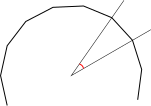
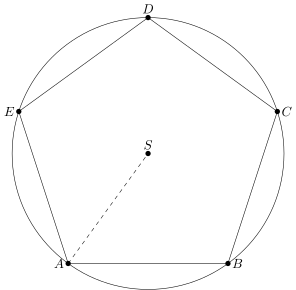
Consider a regular polygon with the central angle of \(15^{\circ}\). In the figure the cut of a regular polygon with unspecified number of vertices is shown. The red angle is the central angle of the polygon. Find the number of vertices of this polygon.
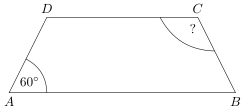
The isosceles trapezium \( ABCD \) is in the picture. The measure of the angle \( DAB \) is \( 60^{\circ} \). Determine the measure of the angle \( BCD \).
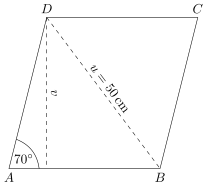
\( ABCD \) is a rhombus, the measure of the angle \( DAB \) is \(70^{\circ}\) and the shorter diagonal \( u = 50\,\mathrm{cm} \). Determine the height \(v\) of the rhombus. Round the result to two decimal places.
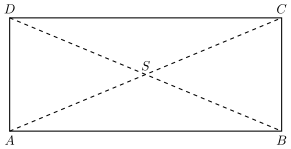
The side lengths of the rectangle \( ABCD \) are in the ratio \( AB: BC=4:3 \). Give the degree measure of the angle \( ASB \). Round the result to two decimal places.
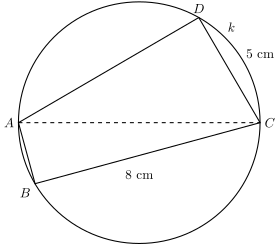
Consider a circle \( k \) with radius \( 5\,\mathrm{cm} \). In the circle is inscribed a convex quadrilateral \( ABCD \) so that the diagonal \( AC \) is the diameter of the circle, the length of \( BC \) is \( 8\,\mathrm{cm} \), and the length of \( DC \) is \( 5\,\mathrm{cm} \). Determine the length of side \( AD \). (See the picture.)
A diagonal of a rectangle has length of \( 26\,\mathrm{cm} \) and the perimeter of the rectangle is \( 68\,\mathrm{cm} \). Find the difference of the length and the width of the rectangle in centimeters.