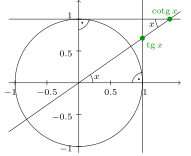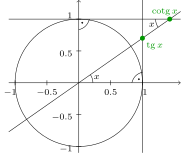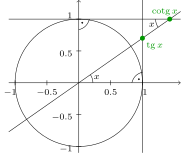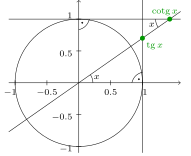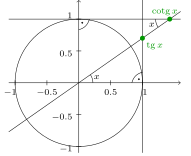
9000032010 Parte: A\(\mathop{\mathrm{cotg}}\nolimits \left ( \frac{\pi }{4}\right ) = ?\)\(1\)\(\frac{\sqrt{2}} {2} \)\(0\)\(-\frac{\sqrt{3}} {3} \)\(\frac{\sqrt{3}} {3} \)no definido
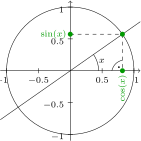
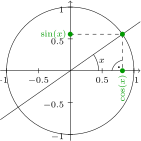
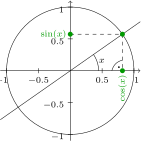
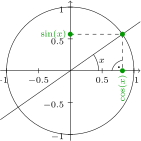
9000032113 Parte: A\(\sin \left ( \frac{\pi }{6}\right ) = ?\)\(\frac{1} {2}\)\(\frac{\sqrt{2}} {2} \)\(-\frac{1} {2}\)\(\frac{\sqrt{3}} {2} \)\(\sqrt{3}\)\(0\)
9000032011 Parte: A\(\mathop{\mathrm{tg}}\nolimits \left ( \frac{\pi }{3}\right ) = ?\).\(\sqrt{3}\)\(0\)\(-\sqrt{3}\)\(-\frac{\sqrt{3}} {3} \)\(-\frac{\sqrt{2}} {2} \)\(\frac{\sqrt{3}} {3} \)
9000032114 Parte: A\(\cos \left ( \frac{\pi }{6}\right) = ?\)\(\frac{\sqrt{3}} {2} \)\(\frac{\sqrt{2}} {2} \)\(-\frac{1} {2}\)\(-\frac{\sqrt{3}} {2} \)\(0\)\(-\frac{\sqrt{2}} {2} \)
9000032013 Parte: A\(\mathop{\mathrm{tg}}\nolimits \left ( \frac{\pi }{6}\right ) = ?\)\(\frac{\sqrt{3}} {3} \)\(0\)\(-\sqrt{3}\)\(-\frac{\sqrt{3}} {3} \)\(\frac{\sqrt{2}} {2} \)\(-\frac{\sqrt{2}} {2} \)
9000033801 Parte: B¿Cuál de los números en la lista es un período (no necesariamente el período más pequeño) de la función \(m\colon y =\cos x\)?\(4\pi \)\(\pi \)\(5\pi \)\(3\pi \)
9000032014 Parte: A\(\mathop{\mathrm{cotg}}\nolimits \left ( \frac{\pi }{6}\right ) = ?\)\(\sqrt{3}\)\(-\frac{1} {2}\)\(-\frac{\sqrt{3}} {2} \)\(0\)no definido\(-\sqrt{3}\)
9000033802 Parte: B¿Cuál de los números en la lista es un período (no necesariamente el período más pequeño) de la función \(n\colon y =\mathop{\mathrm{tg}}\nolimits x\)?\(3\pi \)\(\frac{\pi }{2}\)\(- \frac{\pi } {2}\)\(\frac{3\pi } {2}\)
9000032101 Parte: A\(\sin \left ( \frac{\pi }{2}\right ) = ?\)\(1\)\(-\frac{\sqrt{2}} {2} \)\(-\sqrt{3}\)\(\sqrt{3}\)\(\frac{\sqrt{2}} {2} \)\(\frac{\sqrt{3}} {3} \)
9000033804 Parte: BEn la siguiente lista, identifica una proposición verdadera sobre la función \(g\colon y =\sin x\), \(x\in [ - 2\pi ;-\pi ] \).La función \(g\) no es ni creciente ni decreciente.La función \(g\) es creciente.La función \(g\) es decreciente.