Consider an isosceles triangle, i.e. the triangle with two
sides of equal length. The length of the third side is
\(4\, \mathrm{cm}\). One of the
interior angles is \(120^{\circ }\).
Find the area of this triangle.
Identify the optimal first step convenient to solve the following trigonometric
equation. Do not consider the step which is possible but does not help to solve the
equation.
\[
\sin 2x =\mathop{\mathrm{tg}}\nolimits x
\]
\(2\sin x\cdot \cos x = \frac{\sin x}
{\cos x}\)
substitution \( 2x = z\)
\(\sin x = \frac{\mathop{\mathrm{tg}}\nolimits x}
{2} \)
The parallelogram has sides of the length
\(5\, \mathrm{cm}\) and
\(4\, \mathrm{cm}\) (see the picture). The area of this
parallelogram is \(S = 10\sqrt{2}\, \mathrm{cm}^{2}\).
Find the measure of the smaller of the interior angles.
Identify the optimal first step convenient to solve the following trigonometric
equation. Do not consider the step which is possible but does not help to solve the
equation.
\[
2\cos ^{2}x =\sin x + 1
\]
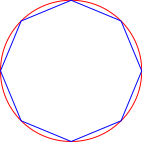
Find the area of the regular octagon of the perimeter
\(16\, \mathrm{cm}\).
Round the result to two decimal places. (The regular octagon is a polygon which has
eight sides of equal length, see the picture. The perimeter of the octagon is the sum
of the length of all eight sides.)
The base of a pyramid is a square with the side of \(2\, \mathrm{cm}\). The height of the pyramid is \(4\, \mathrm{cm}\). Find the angle between the lateral side of the pyramid and the base. Round your result to two decimal places.
Consider the function \(f\colon y = A\cdot \sin (B\cdot x + C)\), with
real nonzero parameters \(A\),
\(B\) and
\(C\).
Which of the following operations makes the amplitude of the function five times
bigger?