Identify the real number \(x\) which
ensures that the numbers \(a_{1} = -x\),
\(a_{2} = -5\) and
\(a_{3} = 0\) are
three consecutive terms of an arithmetic sequence.
Identify the real number \(x\) which
ensures that the numbers \(a_{1} = 5x + 1\),
\(a_{2} = x\) and
\(a_{3} = 7x + 3\) are
three consecutive terms of an arithmetic sequence.
Identify the real number \(x\) which
ensures that the numbers \(a_{1} = -12\),
\(a_{2} = x\) and
\(a_{3} = 24\) are
three consecutive terms of an arithmetic sequence.
Find \(N\),
the number of the turns, as a function of the other variables in the formula for the
magnetic induction of a solenoid.
\[
B =\mu \frac{NI}
{l}
\]
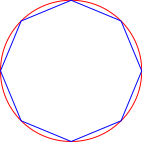
A circle is circumscribed to the regular octagon. The perimeter of the octagon is
\(16\, \mathrm{cm}\). Find
the radius of the circle and round the result to two decimal places. (The regular
octagon is a polygon which has eight sides of equal length. The perimeter of the
octagon is the sum of the length of all eight sides.) Circle circumscribed to the regular octagon.
Find the focus length \(f\)
as a function of the other variables from the following equation relating this distance with object
and image distances \(a\)
and \(a'\).
\[
\frac{1}
{f} = \frac{1}
{a} + \frac{1}
{a'}
\]