The tree of the height \(12\, \mathrm{m}\)
is observed from the place horizontal with the base of the tree. The angle of elevation
is \(10^{\circ }\).
Find the distance of the observer from the base and round to the nearest meters.
Sun shines to the road at the angle \(53^{\circ }22'\).
An electric column near the road casts the shadow of the length
\(4.5\, \mathrm{m}\). Find
the height of the column and round your answer to the nearest meters.
Two forces act on the body at one point. The force
\(F_{1} = 760\, \mathrm{N}\)
acts horizontally from left to the right and the force
\(F_{2} = 28.8\, \mathrm{N}\) acts
vertically from the top to the bottom. Find the angle between the horizontal direction
and the direction of the resulting force and round your answer to the nearest degrees
and minutes.
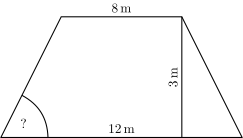
The height of a right trapezoid is \(4\, \mathrm{cm}\).
The length of the longer base is \(7\, \mathrm{cm}\)
and the angle between this base and the leg of the trapezoid is
\(52^{\circ }\). Find
the perimeter of the trapezoid and round to the nearest centimeters. See the picture with a right trapezoid.
The angle of elevation of a straight road is \(3^{\circ }30'\).
The distance between two places measured along the road is
\(2\, \mathrm{km}\). For these places, find the difference in altitudes, i.e. the vertical distance, and round the result to the nearest meter. (See the picture.)
A roof gable has the shape of an isosceles triangle with the base of \(14\, \mathrm{m}\).
The angle between the roof and the horizontal direction is
\(31^{\circ }\). Find the height of the gable. Round your result to one decimal place.
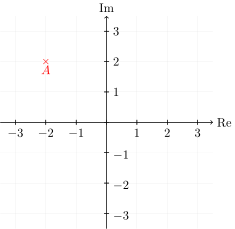
The number \(\cos \frac{7}
{6}\pi + \mathrm{i}\sin \frac{7}
{6}\pi \)
is a solution of a quadratic equation with real valued coefficients. Find the second
solution.