Find the number of positive integers with three mutually different digits which can be written just
using the digits \(2\),
\(3\),
\(4\),
\(5\) and which can
be divided by \(3\).
Find the number of positive integers with three mutually different digits which can be written just
using the digits \(2\),
\(3\),
\(4\),
\(5\) and which can
be divided by \(4\).
Find the number of mutually different isosceles triangles (at least
two sides are equal) such that each side of each triangle is either
\(2\),
\(3\),
\(4\) or
\(5\).
Find the number of mutually different triangles such that all
three sides of each triangle are mutually different and each side is
\(2\),
\(3\),
\(4\) or
\(5\).
Determine the number of three-digit positive integers that can be formed using the digits \(2\),
\(3\),
\(4\) and
\(5\). The digits can be used repeatedly.
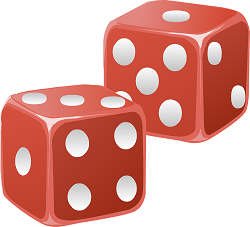
Little John plays a dice game against Robin Hood. To win, he needs to get the sum of \(8\) by rolling two dice. What is the probability that he wins over Robin right on the first roll? Round your result to three decimal places.
Find a set of the values of the real parameter
\(a\) which
ensure that the following equation has a unique solution.
\[
a^{3}x + 4a - 1 = a^{2}x + 3
\]
Find a set of the values of the real parameter
\(a\) which
ensure that the following equation has infinitely many solutions.
\[
a^{2}x + 2ax - 3x = a - 2
\]