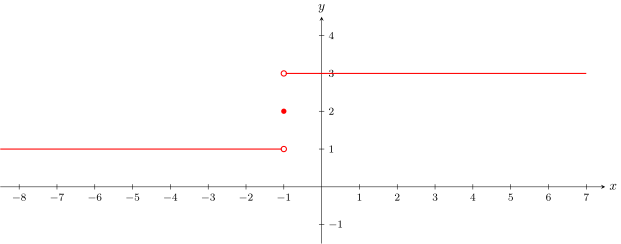
Funkcja signum (sgn) jest zdefiniowana w celu przypisania $-1$ do liczb ujemnych, $0$ do zera a $+1$ do liczb dodatnich. Studenci Adam, Bob, Chris i David mieli za zadanie znaleźć następujący limit: $$ \lim_{x\rightarrow -1^+} \left[\mathrm{sgn} (x + 1) + 2\right] $$
Czy któryś z nich poprawnie znalazł granicę? Sprawdź cały sposób rozwiązania, nie tylko wartość wynikową.
Adam: $$ \lim_{x\rightarrow -1^+} \left[\mathrm{sgn} (x + 1) + 2\right] = \mathrm{sgn} (-1 + 1) + 2 = \mathrm{sgn}\, 0 + 2 = 0 + 2 = 2 $$
Bob: $$ \lim_{x\rightarrow -1^+} \left[\mathrm{sgn}(x + 1) + 2\right] = \lim_{x\rightarrow -1^+} \mathrm{sgn} (x + 1 + 2) = \mathrm{sgn} (-1 + 3) =\mathrm{sgn} (2) = 1 $$
Chris: $$ \lim_{x\rightarrow -1^+} \left[\mathrm{sgn} (x + 1) + 2\right] = \lim_{x\rightarrow -1^+} (\mathrm{sgn}\, x) + 1 + 2 = \mathrm{sgn} (-1) + 3 = -1 + 3 = 2 $$
David: $$ \lim_{x\rightarrow -1^+} \left[\mathrm{sgn} (x + 1) + 2\right] = \lim_{x\rightarrow -1} \mathrm{sgn} (x + 1) = \mathrm{sgn}\, 0 = 0 $$
Nikt
Adam
Bob
David
Chris
Funkcja $f$nie jest ciągły od prawej strony w $x = −1$, więc granica z prawej strony w tym punkcie nie jest równa wartości funkcji. Jednostronne granice w punktach $x = −1$ wynikają z wykresu funkcji $f$ (patrz rysunek): Limit od lewej strony to $1$, granica od prawej strony to $3$. Limit dwustronny nie istnieje. $$ \lim_{x\rightarrow -1^+} \left[\mathrm{sgn} (x + 1) + 2\right] =3. $$