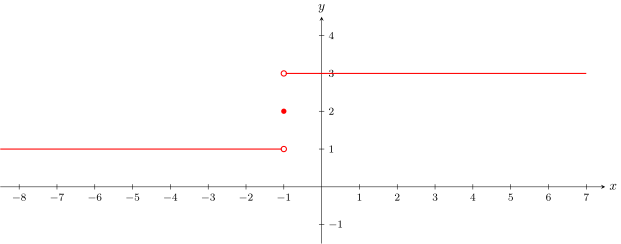
La función signo (sgn) está definida para asignar $-1$ a los números negativos, $0$ al cero y $+1$ a los números positivos. Los estudiantes Adam, Bob, Chris y David tuvieron que hallar el siguiente límite:
$$ \lim_{x\rightarrow -1^+} \left[\mathrm{sgn} (x + 1) + 2\right] $$
¿Cuál de los estudiantes lo halló correctamente? Comprueba sus soluciones.
Adam: $$ \lim_{x\rightarrow -1^+} \left[\mathrm{sgn} (x + 1) + 2\right] = \mathrm{sgn} (-1 + 1) + 2 = \mathrm{sgn}\, 0 + 2 = 0 + 2 = 2 $$
Bob: $$ \lim_{x\rightarrow -1^+} \left[\mathrm{sgn}(x + 1) + 2\right] = \lim_{x\rightarrow -1^+} \mathrm{sgn} (x + 1 + 2) = \mathrm{sgn} (-1 + 3) =\mathrm{sgn} (2) = 1 $$
Chris: $$ \lim_{x\rightarrow -1^+} \left[\mathrm{sgn} (x + 1) + 2\right] = \lim_{x\rightarrow -1^+} (\mathrm{sgn}\, x) + 1 + 2 = \mathrm{sgn} (-1) + 3 = -1 + 3 = 2 $$
David: $$ \lim_{x\rightarrow -1^+} \left[\mathrm{sgn} (x + 1) + 2\right] = \lim_{x\rightarrow -1} \mathrm{sgn} (x + 1) = \mathrm{sgn}\, 0 = 0 $$
Nadie
Adam
Bob
David
Chris
La función $f$ no es continua por la derecha en $x = −1$, por lo que el límite por la derecha en este punto no es igual al valor de la función. Los límites unilaterales en $x = −1$ se ven claramente en la gráfica de la función $f$ (mira la imagen): El límite por la izquierda es $1$, el límite por la derecha es $3$. El límite bilateral no existe.