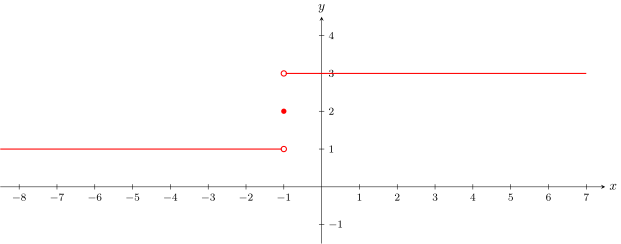
The function signum (sgn) is defined to assign $-1$ to negative numbers, $0$ to zero and $+1$ to positive numbers. Students Adam, Bob, Chris and David were tasked to find the following limit:
$$ \lim_{x\rightarrow -1^+} \left[\mathrm{sgn} (x + 1) + 2\right] $$
Did any of them correctly find the limit? Check the whole way of solving, not only the resulting value.
Adam: $$ \lim_{x\rightarrow -1^+} \left[\mathrm{sgn} (x + 1) + 2\right] = \mathrm{sgn} (-1 + 1) + 2 = \mathrm{sgn}\, 0 + 2 = 0 + 2 = 2 $$
Bob: $$ \lim_{x\rightarrow -1^+} \left[\mathrm{sgn}(x + 1) + 2\right] = \lim_{x\rightarrow -1^+} \mathrm{sgn} (x + 1 + 2) = \mathrm{sgn} (-1 + 3) =\mathrm{sgn} (2) = 1 $$
Chris: $$ \lim_{x\rightarrow -1^+} \left[\mathrm{sgn} (x + 1) + 2\right] = \lim_{x\rightarrow -1^+} (\mathrm{sgn}\, x) + 1 + 2 = \mathrm{sgn} (-1) + 3 = -1 + 3 = 2 $$
David: $$ \lim_{x\rightarrow -1^+} \left[\mathrm{sgn} (x + 1) + 2\right] = \lim_{x\rightarrow -1} \mathrm{sgn} (x + 1) = \mathrm{sgn}\, 0 = 0 $$
Nobody
Adam
Bob
David
Chris
The function $f$ is not continuous from the right at $x = −1$, so the limit from the right at this point does not equal the function value. The one-sided limits at $x = −1$ are clear from the graph of the function $f$ (see the picture): The limit from the left is $1$, the limit from the right is $3$. The two-sided limit does not exist. $$ \lim_{x\rightarrow -1^+} \left[\mathrm{sgn} (x + 1) + 2\right] =3. $$