Analytical space geometry

2010008704

Level: 
C
A cube \( ABCDEFGH \) with an edge length of \( 3 \) is placed in a coordinate system (see the picture). Find the distance between parallel planes \( \rho \) and \( \sigma \), where \( \rho \) is passing through \( D \), \( E \) and \( G \) and \( \sigma \) is passing through \( A \), \( C \) and \( F \).
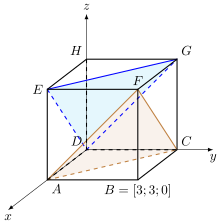
\( |\rho\sigma|=\sqrt3 \)
\( |\rho\sigma|=\frac{2\sqrt3}3 \)
\( |\rho\sigma|=\frac{3\sqrt3}2 \)
\( |\rho\sigma|=\frac{4\sqrt3}3 \)
2010008705

Level: 
C
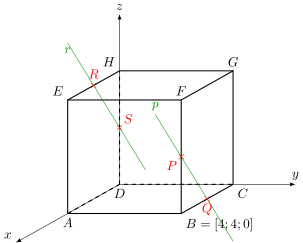
A cube \( ABCDEFGH \) with an edge length of \( 4 \) units is placed in a coordinate system (see the picture). Find the distance of parallel lines \( p=PQ\) and \( r=RS \), where points \( P \), \( Q \), \( R\) and \( S \) are midpoints of edges \(BF\), \(BC\), \(EH\) and \(DH\) respectively.
\( |pr|=2\sqrt6 \)
\( |pr|=4\sqrt3 \)
\( |pr|=6\sqrt2 \)
\( |pr|=4\sqrt2 \)

2010008706

Level: 
C
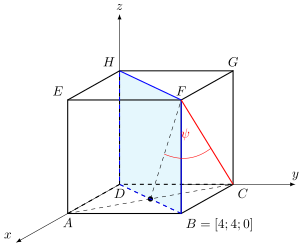
A cube \( ABCDEFGH \) with an edge length of \( 4 \) units is placed in a coordinate system (see the picture). Find an angle \( \psi \) between the plane \( \rho \) passing through the points \( B \), \( D \) and \( H \) and the straight line \( CF \). Hint: An angle between a line and a plane is an angle between the line and its orthogonal projection into this plane.
\( \psi = \frac{\pi}6 \)
\( \psi = \frac{\pi}{12} \)
\( \psi = \frac{\pi}4 \)
\( \psi = \frac{\pi}3 \)

2010008707

Level: 
C
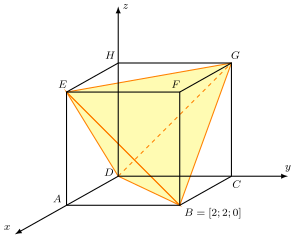
Let \(ABCDEFGH\) be a cube with an edge length of \(2\) units placed in the rectangular coordinate system. In the cube a regular tetrahedron \(BDEG\) is highlighted (see the picture). Find the angle between its faces and round the number to the nearest minute.
\(70^{\circ}32'\)
\(45^{\circ}0'\)
\(51^{\circ}4'\)
\(54^{\circ}44'\)

2010008908

Level: 
C
We are given skew lines $a$ and $b$. \begin{align*} a\colon x&= -1-2t, & b\colon x&= 1-3s, \\ y&= -2+3t, & y&=2s, \\ z&= -4+2t;\ t\in\mathbb{R}, & z&= 2-2s;\ s\in\mathbb{R}. \end{align*} Find parametric equations of a straight line $p$, that is intersecting both lines $a$ and $b$ and lying in the plane $2x+3y-z-8=0$.
$\begin{aligned} p\colon x&=-9+r, \\ y&=10+r, \\ z&=4+5r;\ r\in\mathbb{R} \end{aligned}$
$\begin{aligned} p\colon x&=-9-2r, \\ y&=10-2r, \\ z&=4+10r;\ r\in\mathbb{R} \end{aligned}$
$\begin{aligned} p\colon x&=-9-10r, \\ y&=10+9r, \\ z&=4-r;\ r\in\mathbb{R} \end{aligned}$
$\begin{aligned} p\colon x&=-9+2r, \\ y&=10+2r, \\ z&=4-2r;\ r\in\mathbb{R} \end{aligned}$

2010016101

Level: 
C
If the equation \( x^2+y^2+z^2+2x-8y+z+17=0\) is the equation of a sphere, find its center \(S\) and radius \(r\).
\( S= \left[ -1;4;-\frac12\right]\), \(r=\frac12\)
\( S= \left[ -1;4;-\frac12\right]\), \(r=\frac14\)
\( S= \left[ 1;-4;\frac12\right]\), \(r=\frac12\)
\( S= \left[ 1;-4;\frac12\right]\), \(r=\frac14\)
It is not a sphere equation.