
Albert received one million dollars from his grandfather as a gift for his twentieth birthday. He thought of depositing the money into a bank account and withdrawing it in $20$ years. He hoped to triple the amount by that time and so he wondered what the minimum annual interest rate is he should deposit his money at. Since he could not calculate the required rate himself, he asked a few of his classmates from the University of Economics for help:
Bob: The interest rate remains constant throughout the years, which means that the amount of the money in the bank account grows linearly. We can, therefore, describe this amount using a linear function $y=v(1+ax)$, where $x$ is the saving period (in our case in years), $y$ is the amount of money in the bank account after $x$ years, and $v$ represents the initial deposit (in our case $v$ equals $1$, representing one million dollars). The coefficient $a$ is the annual interest rate, which we can calculate based on Albert’s requirement: “In twenty years, I want to triple the money!”
We substitute ($v=1$, $x=20$, $y=3v=3$): $$ \begin{aligned} y=v(1+ax)\cr 3=1+20a \cr \bf{a=0.1} \end{aligned} $$
Thus, the minimum interest rate should be $10\%$ per year, and the amount in the bank account would grow as follows:
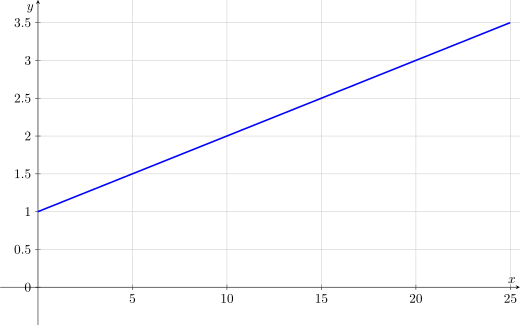
In the picture: On the horizontal axis, the values show the number of years of saving, and on the vertical axis, they show the amount of money (in millions) in the bank account.
Cecilia: ”If I remember correctly from school, the rate at which the amount in the account grows gradually increases over time because interest is also earned on previously accumulated interest. That corresponds to a quadratic function (graph is a parabola) meaning Bob’s equation should be modified by squaring $x$:” $$ \begin{aligned} y=v(1+ax^2) \cr 3=1+400a \cr \bf{a=0.005} \end{aligned} $$
So, the minimum interest rate should be $0.5\%$ per year, and the amount in the bank account would grow as follows:
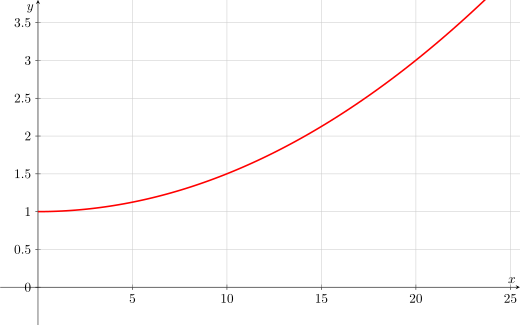
In the picture: On the horizontal axis, the values show the number of years of saving, and on the vertical axis, they show the amount of money (in millions) in the bank account.
David: ”I agree with Cecilia that we cannot use a linear function. However, her calculation is definitely incorrect. The annual interest rate of $0.5\%$ cannot result in tripling the amount even after $20$ years. I remember that we used an exponential function for such calculations:” $$ \begin{aligned} y=v(1+a)^x\cr 3=(1+a)^{20} \cr \bf{a \doteq 0.05647} \end{aligned} $$
Thus, the minimum interest rate should be approximately $5.647\%$ per year, and the amount in the account would grow as follows:
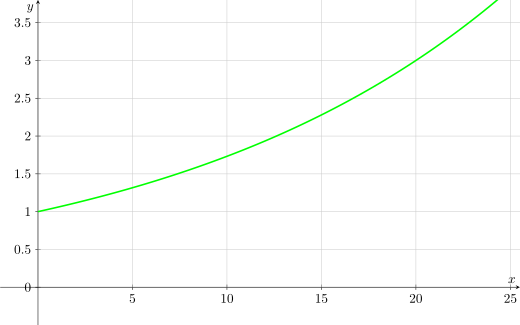
In the picture: On the horizontal axis, the values show the number of years of saving, and on the vertical axis, they show the amount of money (in millions) in the bank account.
Bob
Cecilia
David
Nobody
If the initial amount of $v$ is deposited, then after the first year, the interest of $va$ will be credited. The total amount in the account will then be: $$ v+va=v(1+a) $$
After the second year, interest of $v(1+a)a$ will be added to the amount of $v(1+a)$. So, after the second year the amount on the account will be: $$ v(1+a)+v(1+a)a=v(1+a)(1+a)=v(1+a)^2 $$
Generalizing this approach, after $x$ years, money in the account will amount to: $$ v(1+a)^x $$


