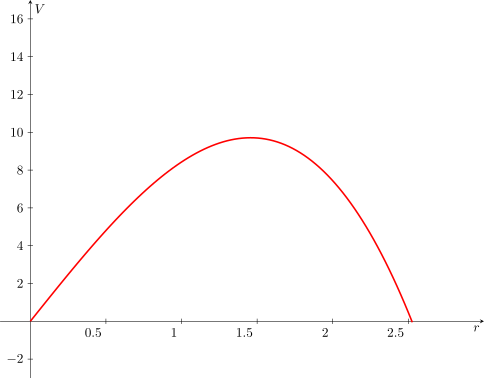
Pat and Mat were given $20\,\mathrm{m}^2$ of tiles suitable for tiling curved surfaces. They decided to dig and tile a circular pool (in the shape of a cylinder) in their garden. Pat proposed a pool with a small diameter that would be very deep (small-surfaced pool). Mat disliked this idea, saying it resembled a well rather than a pool. Instead Mat suggested a pool with larger diameter, which, due to the limited number of tiles, would be very shallow. Their uncle Pepin, who happened to pass by, remarked that the pool with the largest volume would have the same radius as its depth. He also mentioned that it is actually simple to calculate.
Excited by the challenge, Pat and Mat started their calculations:
(1) Pat reasoned: If $r$ is the pool radius and $h$ is the pool depth, then the volume of the pool is given by: $$ V = \pi r^2 h $$ If we require the maximal pool volume, we need to find the maximum value of the function $V$, which currently depends on two variables, $r$ and $h$.
(2) Additionally, Mat realized that there is a relation between $r$ and $h$, as the surface area to be tiled is exactly $20\,\mathrm{m}^2$. This surface area corresponds to the lateral surface area of the cylinder plus the area of its single circular base, i.e., $S = \pi r^2 + 2\pi r h $. They got the equation: $$ 20 = \pi r^2 + 2\pi r h $$ establishing the relation between $r$ and $h$. From this equation they expressed $h$ in terms of $r$: $$ h = \frac{20−\pi r^2}{ 2\pi r} = \frac{10}{\pi r} − \frac{r}{2} $$ Moreover, Pat and Mat realized that $r $ and $h$ must be positive since $r $ is the radius of the pool and $h$ is its depth. So, they wrote the condition: $$ \frac{10}{\pi r} − \frac{r}{2} > 0, $$ i.e., $$ 0 < r < r_{\mathrm{max}} = \sqrt{\frac{20}{\pi} } $$
(3) Pat and Mat then substituted the obtained expression for $h$ into the equation for the volume $V = \pi r^2 h $ and obtained $V$ as a function of $r$ alone: $$ V(r ) = \pi r^2 \left( \frac{10}{\pi r} − \frac{r}{2} \right) = 10r − \frac{\pi r^3}{2}, $$ where $r \in (0, r_{\mathrm{max}})$.
(4) To find the maximum of the function, they calculated its derivative: $$ V'(r ) = 10 − \frac{3\pi r^2}{ 2} $$ Setting $V'(r ) = 0$ and solving the resulting equation, they found: $$ r_0 = \sqrt{\frac{20}{3\pi}} \doteq 1.46\,\mathrm{m} $$ and verified that $r_0 \in (0, r_{\mathrm{max}}).$
(5) They then verified that on the interval $(0, r_0)$, the derivative $V'(r)$ of the continuous function $V(r)$ is positive, meaning the function $V(r)$ is increasing on $(0,r_0 ]$. Further, on the interval $[ r_0,r_{\mathrm{max}})$, the derivative $V'(r)$ is negative, so the function $V(r)$ is decreasing on $[ r_0,r_{\mathrm{max}})$. This means that at the point $r_0$, the function $V(r)$ has a global maximum on $(0, r_{\mathrm{max}})$. Thus, the radius of the pool with the maximum volume is $r_0$. Substituting $r_0$ into the expression for $h$: $$ h = \frac{10}{\pi r} − \frac{r}{2} , $$ Pat and Mat found the pool depth to be approximately $h \doteq 1.46\,\mathrm{m}$, which is equal to its radius. Apparently, Uncle Pepin was right.
Did Pat and Mat calculate everything correctly? Choose the correct answer.
The whole procedure is correct.
No. There is a mistake in step (1). The relation $V = \pi r^2 h$ is incorrect. It shoul dhave been $V = \pi r h^2$.
No. There is a mistake in step (2). The relation for the pool surface is incorrect. It should have been $S = 2\pi r^2 + 2\pi r h $.
No. There is a mistake in step (3). It should have been $V(r ) = 10\pi r - \frac{r^3}{2}$.
No. The derivative in step (4) is incorrect.
No. There is a mistake in step (5). They found the minimum, not the maximum of the function $V$.
The dependence of the pool volume $V$ on the radius $r$.