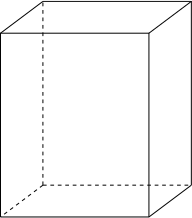
Los lados de un ortoedro son \(a = 3\, \mathrm{cm}\),
\(b = 4\, \mathrm{cm}\) y
\(c = 12\, \mathrm{cm}\). La diagonal espacial es \(u_{t}\) y la diagonal de la cara más corta es \(u_{s}\).
Determina la proporción \(u_{s} : u_{t}\).
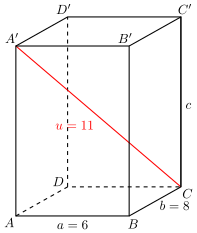
Un ortoedro tiene aristas \(a = 6\, \mathrm{cm}\) y
\(b = 8\, \mathrm{cm}\) y la longitud de la diagonal es
\(u = 11\, \mathrm{cm}\). Determina la longitud de la arista \(c\) (mira la imagen).
Dados los vectores \(\vec{a} = (-1,2,1)\),
\(\vec{b} = (0,-1,1)\) y
\(\vec{c} = (-2,0,1)\), halla la longitud del vector \(\vec{u} =\vec{ a} - 2\vec{b} + \vec{c}\).
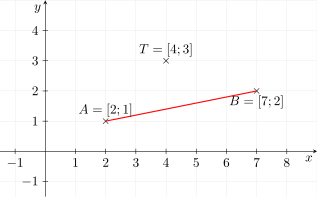
Dados los puntos \( A = [2,1] \), \( B = [7,2] \) y \( T = [4,3] \), donde el punto \( T \) es el baricentro de un triángulo \( ABC \). Determina las coordenadas de \( C \), que es un vértice del triángulo \( ABC \).
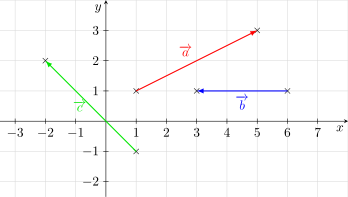
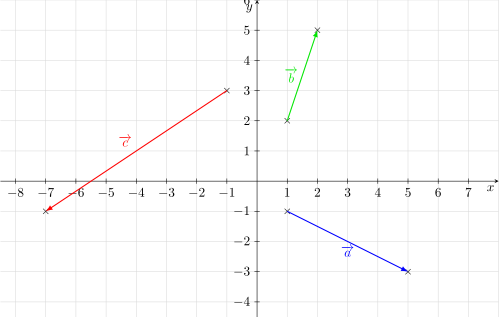
Dados los vectores \( \vec{a} \), \( \vec{b} \), y \( \vec{c} \) mostrados en la imagen, expresa el vector \( \vec{c} \) como combinación lineal de los vectores \( \vec{a} \) y \( \vec{b} \).
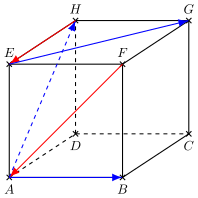
La imagen muestra un ortoedro \( ABCDEFGH \). En el ortoedro determina el vector que es la suma de \( \overrightarrow{AB} + \overrightarrow{AH} + \overrightarrow{EG} + \overrightarrow{FA} + \overrightarrow{HE} \).