A

2010000406

Level: 
A
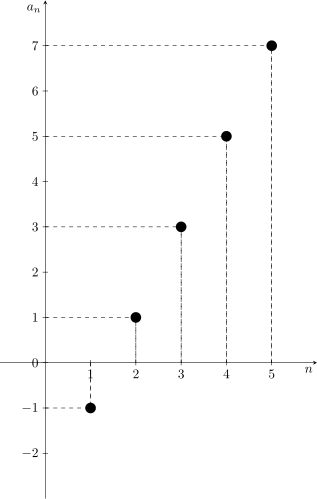
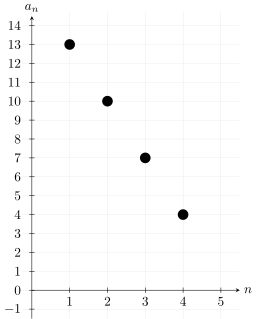
We are given a sequence \( \left( a_n \right)^{5}_{n=1}\) defined by the following graph. Find the formula of the \(n\)th term of this sequence.
\( a_n = 2n-3,\ n \in\{1,\ \ 2,\ \ 3,\ \ 4,\ \ 5 \}\)
\( a_n = 2n,\ n \in\{1,\ \ 2,\ \ 3,\ \ 4,\ \ 5 \}\)
\( a_n = 3-2n,\ n \in\{1,\ \ 2,\ \ 3,\ \ 4,\ \ 5 \}\)
\( a_n = 2n-1,\ n \in\{1,\ \ 2,\ \ 3,\ \ 4,\ \ 5 \}\)

2010000405

Level: 
A
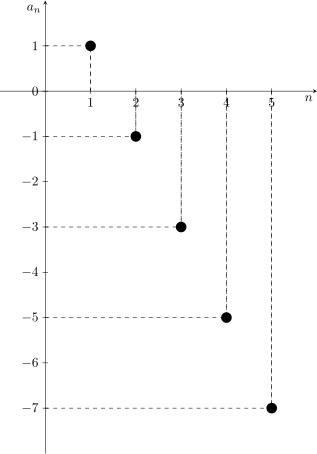
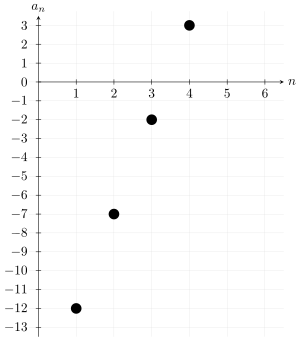
We are given a sequence \( \left( a_n \right)^{5}_{n=1}\) defined by the following graph. Find the formula of the \(n\)th term of this sequence.
\( a_n = 3-2n,\ n \in\{1,\ \ 2,\ \ 3,\ \ 4,\ \ 5 \}\)
\( a_n = 2n,\ n\in\{1,\ \ 2,\ \ 3,\ \ 4,\ \ 5 \}\)
\( a_n = 1-2n,\ n\in\{1,\ \ 2,\ \ 3,\ \ 4,\ \ 5 \}\)
\( a_n = 2n-3,\ n\in\{1,\ \ 2,\ \ 3,\ \ 4,\ \ 5 \}\)

2010000404

Level: 
A
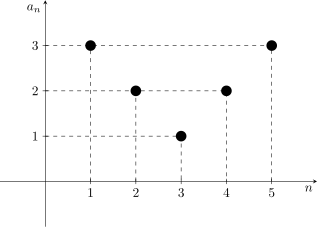
Which sequence is defined by the given graph?
\( \left( a_n \right)^{5}_{n=1} = 3,\ \ 2,\ \ 1,\ \ 2,\ \ 3 \)
\( \left( a_n \right)^{10}_{n=1} = 1,\ \ 3,\ \ 2,\ \ 2,\ \ 3,\ \ 1,\ \ 4,\ \ 2,\ \ 5,\ \ 3 \)
\( \left( a_n \right)^{5}_{n=1} = 1,\ \ 2,\ \ 3,\ \ 4,\ \ 5 \)
\( \left( a_n \right)^{5}_{n=1} = 1,\ \ 2,\ \ 2,\ \ 3,\ \ 3 \)

2010000403

Level: 
A
We are given a sequence \( \left( 5n-3\right)^{\infty}_{n=1} \). What does this formula express?
a sequence of all natural numbers which after dividing by \(5\) give the remainder \(2\)
a sequence of all natural numbers which are divisible by \(3\)
a sequence of all natural numbers which are divisible by \(5\)
a sequence of all natural numbers which after dividing by \(5\) give the remainder \(3\)

2010000401

Level: 
A
We are given a sequence \( \left( \frac{n}{n+1} \right)_{n=1}^{\infty} \). Which of the following formulations describes how is the given sequence defined?
defined by a formula for the \(n\)th term
defined by a list of the sequence elements
defined by a graph of the sequence
defined by a recursive formula for the sequence