A

1103161002

Level: 
A
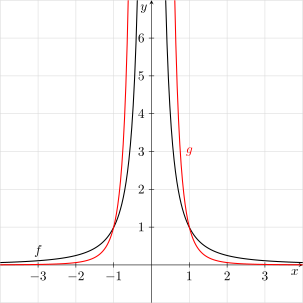
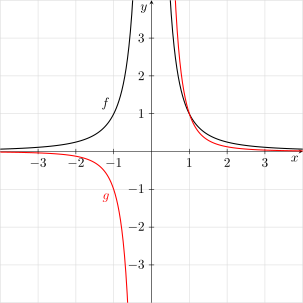
The graphs represent the parts of the functions \( f(x)=x^{-2} \) and \( g(x)=x^{-4} \). Identify which of the following inequalities has the solution set \( (-\infty; -1]\cup[1;\infty) \).
\( x^{-4} \leq x^{-2} \)
\( x^{-2} \leq x^{-4} \)
\( x^{-2} > x^{-4} \)
\( x^{-2} < 1 \)
1103161001

Level: 
A
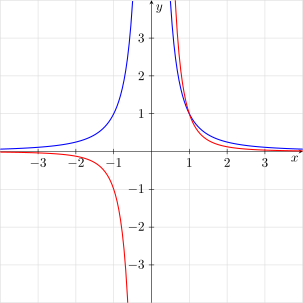
The graphs represent the parts of the functions \( f(x)=x^{-2} \) and \( g(x)=x^{-3} \). Identify which of the following statements is false.
The solution set of the inequality \( x^{-2} > 0 \) is \( (-\infty;\infty) \).
The solution set of the inequality \( x^{-3} > 0 \) is \( (0;\infty) \).
The solution set of the equation \( x^{-3} = x^{-2} \) is \( \{1\} \).
The solution set of the inequality \( x^{-3} < x^{-2} \) is \( (-\infty;0)\cup(1;\infty) \).

1103120004

Level: 
A
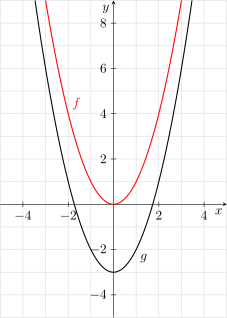
Let \( f(x)=x^2 \). Given the graph of the function \( f \) and the graph of a function \( g \) which was obtained as a vertical shift of the graph of \( f \) (see the picture), choose the function \( g \).
\( g(x) = x^2-3 \)
\( g(x) = (x+3)^2 \)
\( g(x) = x^2+3 \)
\( g(x) = (x-3)^2 \)

1103159303

Level: 
A
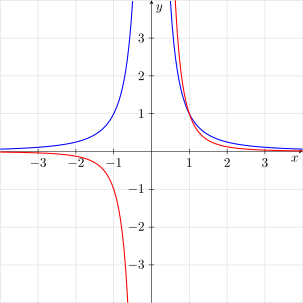
The graphs represent the parts of the functions \( f(x)=x^{-2} \) and \( g(x)=x^{-3} \). Identify which of the following statements is true.
\( -\left(\frac12\right)^{-3} < (-2)^{-3} \)
\( (-2)^{-2} \leq -2^{-2} \)
\( (-2)^{-3} < -2^{-3} \)
\( (-2)^{-3} \leq -2^{-2} \)

1103159302

Level: 
A
The graphs represent the parts of the functions \( f(x)=x^{-3} \) and \( g(x)=x^{-4} \). Identify which of the following statements is true.
\( \left(\frac12\right)^{-3} < \left( \frac12 \right)^{-4} \)
\( 2^{-4} > 2^{-3} \)
\( (-2)^{-4} \leq (-2)^{-3} \)
\( (-1)^{-4} > 1^{-3} \)

1103159301

Level: 
A
The graphs represent the parts of the functions \( f(x)=x^{-2} \) and \( g(x)=x^{-3} \). Identify which of the following statements is false.
\( \left(\frac12\right)^{-3} < 2^{-3} \)
\( \left(-\frac12\right)^{-3} < 2^{-3} \)
\( \left( -\frac12\right)^{-2} \geq (-2)^{-2} \)
\( (-2)^{-2} \geq 2^{-2} \)

1003084910

Level: 
A
We were given a geometric sequence \( \frac12\text{, }\ \frac14\text{, }\ \dots \). What is the formula for the \( n \)th element of the sequence?
\( a_n=\frac1{2^n}\text{, }\ n\in\mathbb{N} \)
\( a_n=\frac1{2^{n+1}}\text{, }\ n\in\mathbb{N} \)
\( a_n=\frac1{2^{n-1}}\text{, }\ n\in\mathbb{N} \)
\( a_n=\frac1{2^{2n}}\text{, }\ n\in\mathbb{N} \)

1003084907

Level: 
A
A sequence \( \left( a_n \right)^{\infty}_{n=1} \) is defined by the relations: \( a_1=3;\ a_{n+1}=\frac{a_n}{n+2}\text{, }n\in\mathbb{N} \). Which of the following descriptions is used to define the given sequence?
a recursion formula of a sequence
a formula of the \(n\)th term
a list of sequence elements
a graph of a sequence

1003084906

Level: 
A
We are given a sequence \( \left( \frac{n+1}n \right)_{n=1}^{\infty} \). Which of the following formulations describes how is the given sequence defined?
defined by a formula for the \( n \)th term
defined by a list of the sequence elements
defined by a graph of the sequence
defined by a recursive formula for the sequence