
Analytical Space Geometry

9000101904

Level: 
B
Find the angle between the \(x\)-axis and the line \(p\). \[ \begin{aligned}p\colon x& = 2 - t, & \\y & = 3t, \\z & = 1,\ t\in \mathbb{R} \\ \end{aligned} \] Round your answer to the nearest minute.
\(71^{\circ }34'\)
\(0^{\circ }\)
\(69^{\circ }17'\)
\(90^{\circ }\)

9000101907

Level: 
B
The general plane \(\alpha \) has the equation \[ \alpha \colon 3z - 4 = 0 \] and the plane \(\beta \) has a normal vector \(\vec{n} = (0,0,1)\). Find the angle between \(\alpha \) and \(\beta \) and round your answer to the nearest degree.
\(0^{\circ }\)
\(30^{\circ }\)
\(45^{\circ }\)
\(90^{\circ }\)

9000101908

Level: 
B
Find the angle between the line \(p\) and the plane \(\alpha \). \[ \alpha \colon x-3z+5 = 0,\qquad \qquad \begin{aligned}[t] p\colon x& = 3, & \\y & = 3t, \\z & = 1 - t,\ t\in \mathbb{R} \\ \end{aligned} \] Round your answer to the nearest minute.
\(17^{\circ }27'\)
\(0^{\circ }\)
\(47^{\circ }33'\)
\(90^{\circ }\)

9000101909

Level: 
B
Given points \(A = [1,0,2]\), \(B = [1,0,0]\) and the plane \(\alpha \), \[ \alpha \colon 2x - 4y = 0, \] find the angle between the line \(AB\) and the plane \(\alpha \). Round your answer to the nearest minute.
\(0^{\circ }\)
\(22^{\circ }48'\)
\(45^{\circ }19'\)
\(90^{\circ }\)

9000101910

Level: 
B
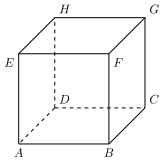
The points \(A = [0,5,0]\), \(B = [5,5,0]\), \(C = [5,0,0]\) and \(D = [0,0,0]\) define the cube \(ABCDEFGH\). Find the angle between the line \(BF\) and the plane \(AFE\). Round your answer to the nearest minute.
\(0^{\circ }\)
\(35^{\circ }16'\)
\(45^{\circ }\)
\(90^{\circ }\)

9000101901

Level: 
B
Find the angle between two lines and round your answer to the nearest minute. \[ \begin{aligned}p\colon x& = 2 - t , & \\y & = 3t , \\z & = 1 ,\ t\in \mathbb{R} \\ \end{aligned}\qquad \qquad \begin{aligned}q\colon x& = 2s, & \\y & = 4s , \\z & = 1 - s,\ s\in \mathbb{R} \\ \end{aligned} \]
\(46^{\circ }22'\)
\(0^{\circ }\)
\(67^{\circ }18'\)
\(90^{\circ }\)
9000101007

Level: 
A
Find the value of the real parameter \(m\) which ensures that the following two lines are identical. \[ \begin{aligned}p\colon x& = 1 + t, & \\y & = 2 - t, \\z & = 1 - t,\ t\in \mathbb{R} \\ \end{aligned}\qquad \qquad \begin{aligned}q\colon x& = s, & \\y & = 1 + s, \\z & = 3 + ms,\ s\in \mathbb{R} \\ \end{aligned} \]
No solution exists.
The lines are identical for every real \(m\).
\(m = -2\)
\(m = 2\)