
Monika and Ester solved the following example:
In a triangle $ABC$, the measure of $\measuredangle ABC$ is $120^{\circ}$, $|AC|=6$, and $|BC|=3$. The segment $CD$ is a bisector of $\measuredangle ACB$. Calculate the length of $DB$.
They both started with the picture:
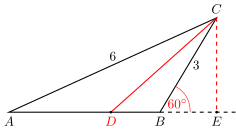
Then, they constructed a line perpendicular to the line $AB$ through the point $C$. In this way, they obtained a right-angled triangle $BEC$ with acute angles $30^{\circ}$, $60^{\circ}$ and the hypotenuse $|BC|=3$.
(1) It was easy to determine the lengths of sides $BE$ and $CE$:
$$
\begin{gather}
|BE|=|BC|\cdot \cos 60^{\circ} =\frac32 \cr
|CE|=|BC|\cdot \sin 60^{\circ} =\frac{3\sqrt3}{2}
\end{gather}
$$
(2) Then, they used the Pythagorean theorem to calculate the length of $AE$: $$ |AE|=\sqrt{|AC|^2-|CE|^2}= \sqrt{36-\frac{27}{4}}=\frac{3\sqrt{13}}{2} $$ (3) From there, they calculated the length of $AB$: $$ |AB|=|AE|-|BE|=\frac{3\sqrt{13}-3}{2} $$
Monika continued this way:
(4) She reasoned that if the line segment $CD$ is an angle bisector, it must also bisect the opposite side $AB$: $$ |DB|=\frac{1}{2} |AB|=\frac{3\sqrt{13}-3}{4} $$
Ester continued as follows:
(4') She reasoned that the angle bisector of any angle of a triangle divides the opposite side in the ratio of the sides containing the angle, i.e.
$$
\frac{|AD|}{|DB|} =\frac{|AC|}{|BC|} =2
$$
(5') Hence $$ \begin{gather} |AD|=2|DB| \cr |DB|=\frac13 |AB|=\frac{3\sqrt{13}-3}{6} \end{gather} $$
Here are some comments. Which one is wrong?
Ester demonstrated the wrong solution. It should have been: $$\frac{|AD|}{|DB|} =\frac{|BC|}{|AC|} =\frac{1}{2}$$
Monika made a mistake in step (4). It is not always true that an angle bisector goes through the midpoint of the opposite side.
Ester presented the correct solution.
Monika demonstrated the wrong solution.
