
Petr, Hanka, Monika, and Honza were tasked with solving a probability problem:
On the table, there are $4$ sealed envelopes with letters and $4$ address labels. Calculate the probability that at least one letter reaches the correct recipient if the secretary randomly sticks the addresses on the envelopes.
The students did not calculate the problem themselves but assigned it to an artificial intelligence. The AI solved the problem as follows:
(1) First, we calculate the total number of ways to place four addresses on four envelopes. This is a permutation of $4$ elements, which is $4!=24$.
(2) Now, let's look at the probability that no letter reaches the correct recipient. This only happens if all four addresses are placed on the wrong envelopes. The number of ways to do this is $3!$ because the first address can go on any of the remaining three envelopes, the second address on one of the remaining two, and so on. This gives us $3!=6$ possibilities.
(3) The probability that none of the recipients receives the correct letter is: $$\frac{6}{24}=0.25$$
(4) Now, we want to find the probability that at least one letter reaches the correct recipient. This can be determined by subtracting the probability that no letter reaches the correct recipient from $1$. So, the probability that at least one recipient gets the correct letter is: $$1-0.25=0.75$$ The students are debating whether the artificial intelligence solved the problem correctly. Who is right?
Monika is convinced that the artificial intelligence made an error in step (2). The number of ways that none of the recipients receives correct letter is $3\cdot3=9$. The desired probability is then: $$1-\frac{9}{24}=0.625$$
Hanka claims that the artificial intelligence did not make any mistakes and calculated the probability correctly.
Petr is concerned about the calculation in step (1). The total number of ways to place addresses on envelopes is $4^4=256$. The desired probability is: $$1-\frac{6}{256}=0.977$$
Honza says that the artificial intelligence made a mistake in step (2). The number of ways that none of the recipients receives correct letter is $6+4+3+2=15$. The desired probability is: $$1-\frac{15}{24}=0.375$$
(1) First, we calculate the total number of possible ways to place four addresses on four envelopes. This is a permutation of $4$ elements, so $4!=24$.
(2) Now, let's examine the probability that no letter reaches the correct recipient. This only happens if all four addresses are placed on the wrong envelopes.
When we incorrectly attach the address from the second letter to the first letter (2), we are left with only $3$ ways to place the remaining three addresses incorrectly.
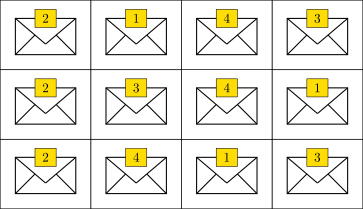
Similarly, if we attach the address from the third or fourth letter to the first letter, we again have only $3$ possibilities to place the remaining addresses incorrectly.
The number of ways to place the addresses on the envelopes so that none of them is correct is, therefore, $3\cdot3=9$ possibilities. The probability that none of the recipients receives the correct letter is: $$\frac{9}{24}=0.375$$
(3) Now, we want to determine the probability that at least one letter reaches the correct recipient. This can be found by subtracting the probability that no letter reaches the correct recipient from $1$. The probability that at least one of the recipients receives the correct letter is, therefore: $$1-0.375=0.625$$
