Identify the real number \(x\) which
ensures that the numbers \(a_{1} = -12\),
\(a_{2} = x\) and
\(a_{3} = 24\) are
three consecutive terms of an arithmetic sequence.
Identify the real number \(x\) which
ensures that the numbers \(a_{1} =\log x\),
\(a_{2} = 2\) and
\(a_{3} =\log x^{3}\) are
three consecutive terms of an arithmetic sequence.
Identify the real number \(x\) which
ensures that the numbers \(a_{1} = x\),
\(a_{2} = x + 2\) and
\(a_{3} = 2x\) are
three consecutive terms of an arithmetic sequence.
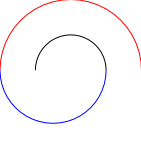
A semicircle is a half of the full circle. An infinite spiral is built from
semicircles with an increasing radius. The radius of the first semicircle is
\(2\, \mathrm{cm}\). The
radius of each semicircle in the spiral is a double of the radius of the previous
semicircle. Find the total length of the spiral.
Identify the real number \(x\) which
ensures that the numbers \(a_{1} =\log x\),
\(a_{2} =\log(2x)\) and
\(a_{3} = 1\) are
three consecutive terms of an arithmetic sequence.
A semicircle is a half of the full circle. An infinite spiral is built from
semicircles with a decreasing radius. The radius of the first semicircle is
\(2\, \mathrm{cm}\). The
radius of each semicircle in the spiral is one half of the radius of the previous
semicircle. Find the total length of the spiral.
A quarter circle is an arc formed by one quarter of the full circle. An infinite spiral is
built from quarter circles with an increasing radius. The radius of the first quarter circle
is \(4\, \mathrm{cm}\).
The radius of each quarter circle in the spiral is one half of the radius of the previous
quarter circle. Find the total length of the spiral.
Consider the square of the side \(4\, \mathrm{cm}\).
The second square is inscribed into this first square by joining the centers of all sides.
In a similar way, the third square is inscribed into the second square by joining the
centers of the sides of the second square and this process continues up to infinity.
Find the sum of the perimeters of all squares.