2000005509 Level: ACalculate the area of a rhombus whose perimeter is \(2\,\mathrm{m}\) and lengths of its diagonals are in the ratio \(3:4\).\(2\,400\,\mathrm{cm}^2\)\(1\,800\,\mathrm{cm}^2\)\(3\,600\,\mathrm{cm}^2\)\(2\,000\,\mathrm{cm}^2\)
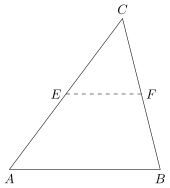
2000005506 Level: AThe picture shows a triangle \(ABC\) with a central transversal \(EF\). The area of the trapezoid \(ABFE\) is \(24\,\mathrm{cm}^2\). What is the area of the triangle \(EFC\)?\(8\,\mathrm{cm}^2\)\(4\,\mathrm{cm}^2\)\(16\,\mathrm{cm}^2\)\(12\,\mathrm{cm}^2\)
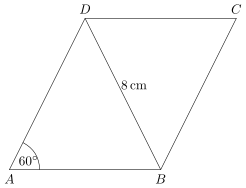
2000005505 Level: AWhat is the perimeter of the rhombus \(ABCD\), if \(|BD|=8\,\mathrm{cm}\) and \(|\measuredangle DAB|=60^{\circ}\) (see the picture)?\(32\,\mathrm{cm}\)\(16\,\mathrm{cm}\)\(28\,\mathrm{cm}\)\(36\,\mathrm{cm}\)
2000005503 Level: AThe diagonals of a quadrilateral \(ABCD\) are halved and perpendicular to each other. What type of quadrilateral is it?square or rhombusrhombussquarerectangle or square
2000005501 Level: ADerive the formula for the area of a square using the length of its diagonal \(u\).\( \frac{u^2}{2}\)\( 4u^2\)\( \frac{u^2}{4}\)\( 2u^2\)
2000005301 Level: AIn real numbers, find the solution set of the following equation. \[\frac{x^2+1}{x^2-9}=0\]\( \emptyset \)\( \pm 1\)\( \pm 3\)\( -1\)
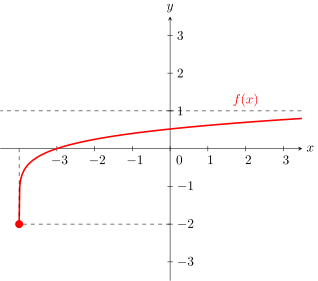
2000005108 Level: AWhich of the following statements about the function \(f\) is correct? (See the picture.)The function is one-to-one.\(D(f)=(-4,\infty)\) and the function is bounded below.The function has a local maximum.The function is odd.
2000005107 Level: AWhich of the following statements about the function \(f\) is correct? (See the picture.)The function is bounded below.\( H(f)=(-2,2) \)The function is even.The function is increasing on the interval \( (2,\infty)\).
2000005106 Level: AWhich of the following statements is not valid for the function \(f\)? (See the picture.)The function is one-to-one.The function is bounded below.\(f(-1) =2\).The value \(-2\) doesn’t belong to the range of \(f\).
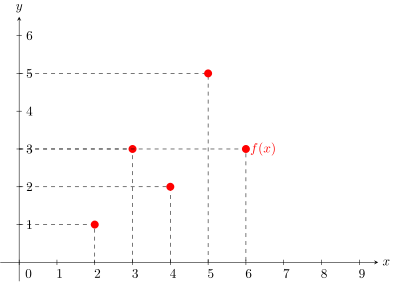
2100005105 Level: AThe pictures show graphs of different functions \(f\). For which of the graphed functions is \(D(f) = \{2,3,4,5,6\}\)?