A

2010006804

Level: 
A
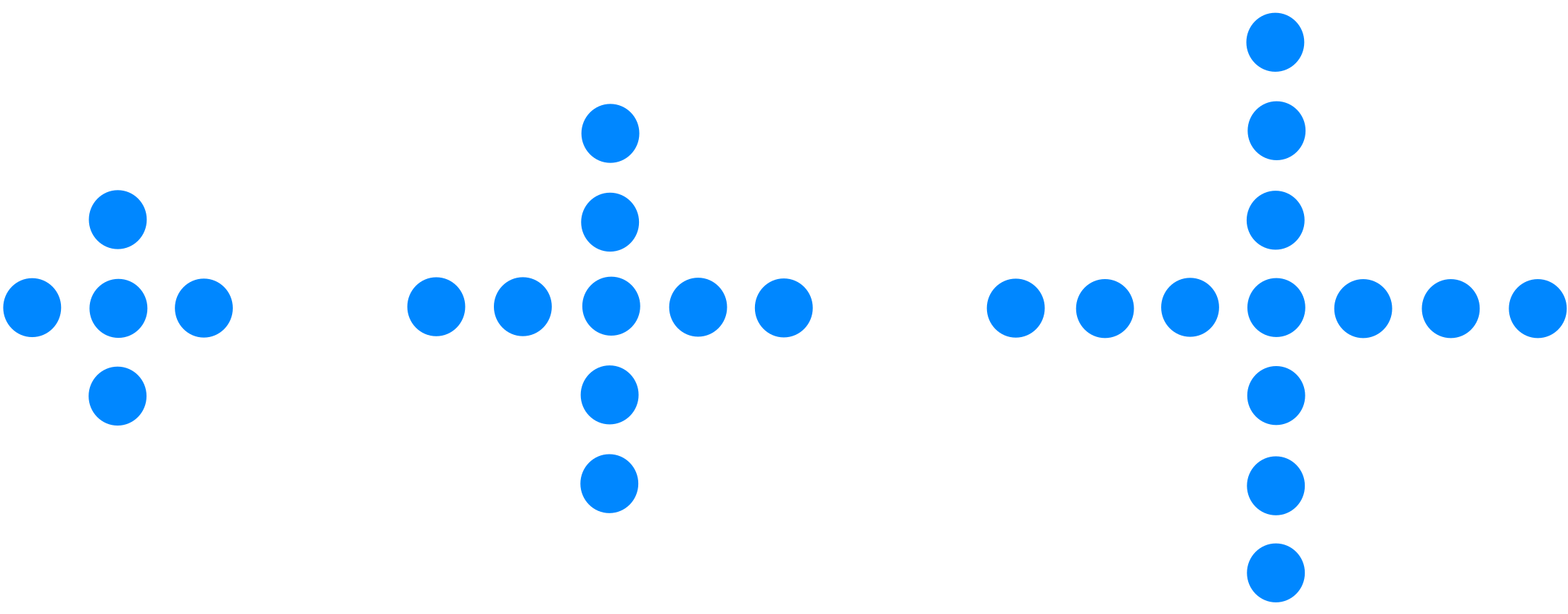
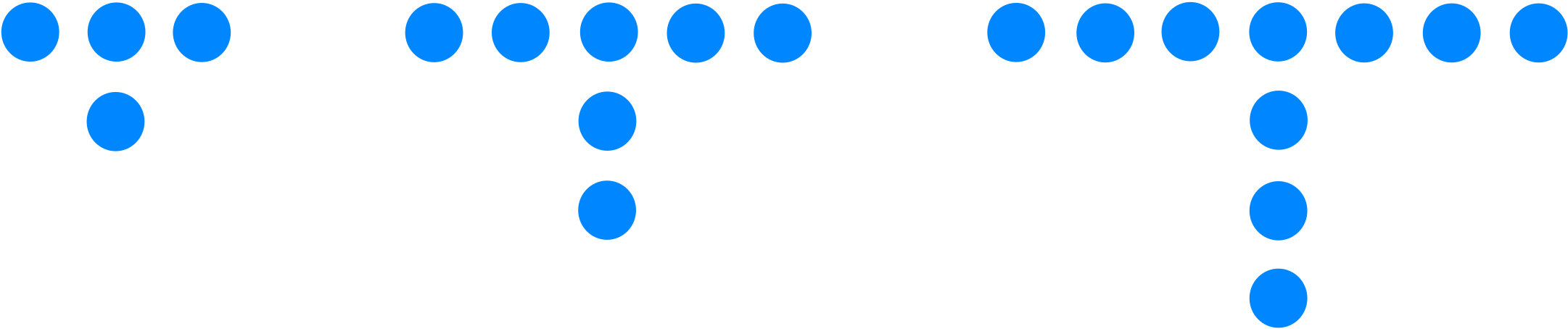
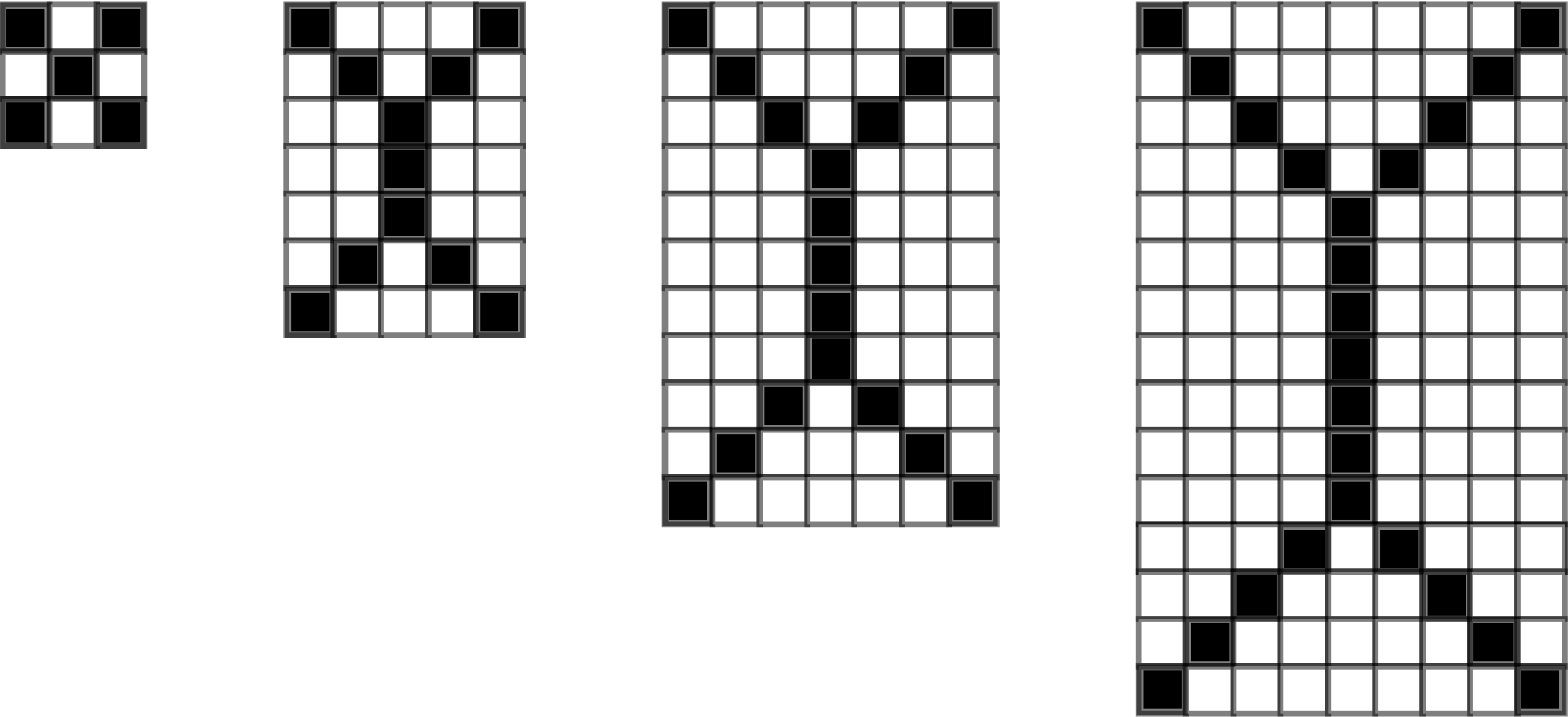
In the picture there are the first four terms of the sequence of patterns that consist of black and white squares. Identify the true statement about the number of squares in these patterns, if you know that exactly one of the given statements is true.
The numbers of white squares in patterns determine an arithmetic sequence with the common difference \(4\).
The numbers of black squares in patterns determine an arithmetic sequence with the common difference \(4\).
The numbers of white squares in patterns determine an arithmetic sequence with the third term \(16\).
The numbers of black squares in patterns determine an arithmetic sequence with the third term \(16\).

2010006803

Level: 
A
In the picture there are the first four terms of the sequence of patterns that consist of black and white squares. Identify the true statement about the number of squares in these patterns, if you know that exactly one of the given statements is true.
The numbers of black squares in patterns determine an arithmetic sequence with the common difference \(6\).
The numbers of white squares in patterns determine an arithmetic sequence with the common difference \(6\).
The numbers of white squares in patterns determine an arithmetic sequence with the first term \(2\).
The numbers of black squares in patterns determine an arithmetic sequence with the first term \(2\).

2010006705

Level: 
A
The perimeter of a rectangle is \(22\, \mathrm{cm}\). The diagonal of this rectangle is \(\sqrt{65}\, \mathrm{cm}\). Find the sides of the rectangle.
\(7\, \mathrm{cm}\) and \(4\, \mathrm{cm}\)
\(14\, \mathrm{cm}\) and \(8\, \mathrm{cm}\)
\(6\, \mathrm{cm}\) and \(5\, \mathrm{cm}\)
\(10\, \mathrm{cm}\) and \(1\, \mathrm{cm}\)

2010006701

Level: 
A
Identify a true statement related to the following matrix \(A\). \[ A = \left (\array{ 2& 4 & -3& 7\cr 9 & -5 & -1 & 8 \cr 11& 0 & 8& 12 \cr -7 & -8 & 1& 13 \cr 9& 10 & -6& 2 } \right ) \]
\(A\) is a \(5\times 4\) matrix and \(a_{(2,\, 3)} = -1\).
\(A\) is a \(5\times 4\) matrix and \(a_{(2,\, 3)} = 0\).
\(A\) is a \(4\times 5\) matrix and \(a_{(2,\, 3)} = 0\).
\(A\) is a \(4\times 5\) matrix and \(a_{(2,\, 3)} = -1\).

2010006503

Level: 
A
Consider the linear system: \[ \begin{aligned}6x - 3y - 42& = 0,& \\\text{???}\quad & = 0. \\ \end{aligned} \] In the following list, identify the missing second equation if you know that the system does not have a solution.
\(- 2x + y +12 = 0\)
\( 2x + y +21 = 0\)
\(3x -2y -12 = 0\)
\(12x -6 y -84 = 0\)