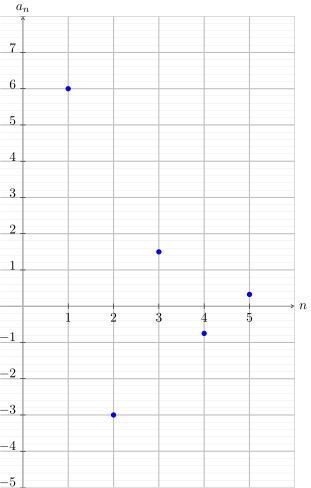
A

2010014209

Level: 
A
In the following list identify a vector having the same direction as the line passing through the points \(A\) and \(B\). \[ A = \left [4;1\right ],\ \qquad B = \left [3;2\right ] \]
\(\left (-1;1\right )\)
\(\left (1;1\right )\)
\(\left (7;3\right )\)
\(\left (5;5\right )\)

2010014202

Level: 
A
Determine the relative position of the lines \( p\colon 6x+4y+8=0 \) and \( q\colon y=-\frac32 x+2 \).
parallel different lines, \( p\parallel q;\ p\neq q \)
intersecting lines, \( p\cap q=\left\{\left[0;-2\right]\right\} \)
intersecting lines, \( p\cap q=\left\{\left[0;2\right]\right\} \)
identical lines, \( p=q \)

2010014010

Level: 
A
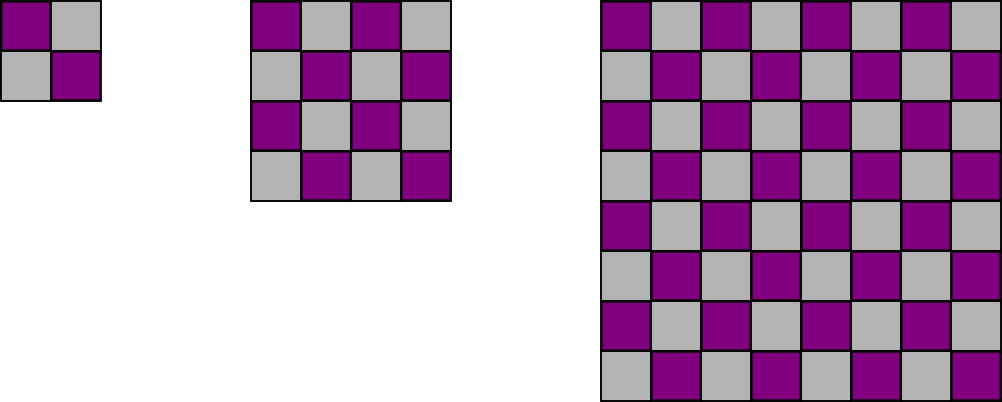
A sequence of patterns uses grey and purple squares. Identify the false statement about the numbers of squares in the patterns.
The numbers of grey squares in patterns do not form a geometric sequence.
The numbers of purple squares in patterns form a geometric sequence with an even common ratio.
The numbers of purple squares in patterns form a geometric sequence with a positive common ratio.
The numbers of grey squares in patterns form a geometric sequence with an even common ratio.

2010014009

Level: 
A
A sequence of patterns uses grey and purple squares. Identify the false statement about the numbers of squares in the patterns.
The numbers of purple squares in patterns form a geometric sequence with an even common ratio.
The numbers of purple squares in patterns form a geometric sequence with a positive common ratio
The numbers of grey squares in patterns form a geometric sequence with a positive common ratio.
The numbers of grey squares in patterns form a geometric sequence with an even common ratio.