A

9000139706

Level: 
A
The international alphabet contains \(26\) letters. The letters of this alphabet and the digits from \(0\) to \(9\) are used to form a code of the length \(4\) (a code contains \(4\) characters). The characters may repeat through the code and the code is not case sensitive (uppercase letters are equivalent to lowercase letters). How many codes can be obtained?
\(36^{4}=1\:679\:616\)
\(10\cdot 26^{4}=4\:569\:760\)
\(\frac{36!} {32!\, 4!}=58\:905\)
\(\frac{26!} {22!\, 4!}=14\:950\)

9000139302

Level: 
A
The phone number contains nine digits. A witness does not remember the full number, but he remembers that the phone number starts by \(728\), ends by \(01\) and there is no repeating digit in the number. How many phone numbers meet these conditions?
\(120\)
\(320\)
\(520\)
\(720\)

9000121708

Level: 
A
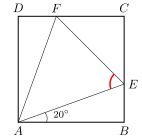
Consider a square \(ABCD\) and a point \(E\) on the side \(BC\) such that the angle \( BAE\) has measure \(20^{\circ }\). The point \(F\) is on the side \(CD\) and the length of \(AF\) equals to the length of \(AE\) (i.e. the triangle \(AEF\) is isosceles with \(AF\) and \(AE\) of equal length). Find the measure of the angle \( AEF\).
\(65^{\circ }\)
\(45^{\circ }\)
\(50^{\circ }\)
\(70^{\circ }\)

9000121709

Level: 
A
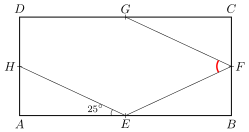
Consider a rectangle \(ABCD\) of a special ratio between the length and the width: if \(E\), \(F\), \(G\) and \(H\) denote the midpoints of the sides \(AB\), \(BC\), \(CD\) and \(DA\), respectively, then the measure of the angle \( AEH\) is \(25^{\circ }\). Find the measure of the angle \( EFG\).
\(50^{\circ }\)
\(65^{\circ }\)
\(75^{\circ }\)
\(130^{\circ }\)

9000121807

Level: 
A
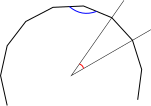
In the figure the cut of a regular polygon with unspecified number of vertices is shown. The red angle is the central angle of the polygon, the blue angle is the interior angle of the polygon. Suppose we consider a regular polygon with the central angle of \(40^{\circ}\), then find the measure of the interior angle of this polygon.
\(140^{\circ }\)
\(80^{\circ }\)
\(200^{\circ }\)
\(120^{\circ }\)

9000117403

Level: 
A
Determine whether the following planes \(\rho \) and \(\sigma \) are parallel, identical or intersecting. \[ \begin{aligned}[t] \rho \colon &x = -u + v, & \\&y = u + 2v, \\&z = -u - v;\ u,v\in \mathbb{R}, \\ \end{aligned}\qquad \sigma \colon x-2y-3z+1 = 0 \]
parallel, not identical
identical
intersecting