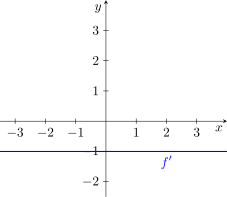
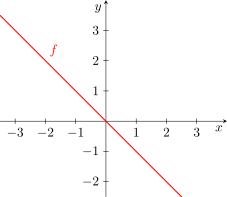
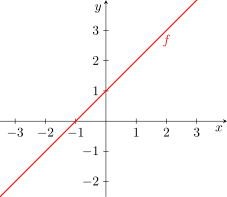
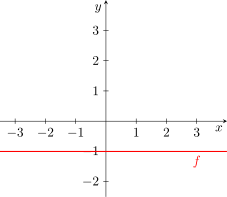
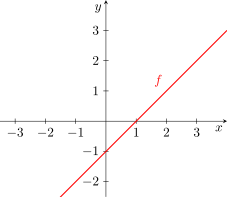
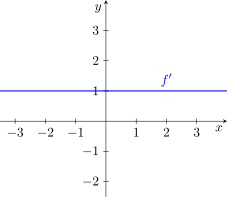
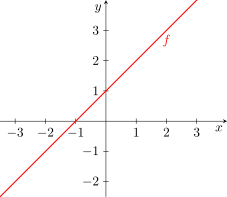
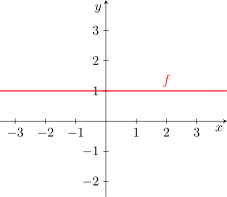
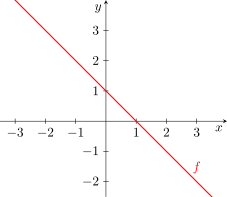
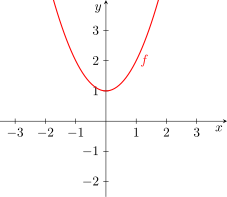
The graph of \( f' \) is given in figure. Function \( f' \) is the derivative of a function \( f \). Choose which of the following graphs is the graph of \( f \).
Assuming \( [x,y]\in\mathbb{R}\times\mathbb{R} \), solve the equation
\[ x-y-\frac{x-y}2=\frac{x-y}3 \]
Decide which of the answers below does not express the set of roots.
Find the sum of all the real roots of the next equation. Multiple roots, if any, count only once.
\[ \left(x^3+8\right)\left(x^2-1\right)\left(x+1\right)=0 \]
For the next equation, find the sum of all the roots from the set of natural numbers. Multiple roots, if any, count only once.
\[ \left(x^3+1\right)\left(x^2-4\right)=0 \]