Identify the real number \(x\)
which converts the numbers \(a_{1} = 3^{x-6}\),
\(a_{2} = 1\) and
\(a_{3} = 3^{x}\) into
three consecutive terms of a geometric series.
At which term does the geometric sequence \( \left( \frac{1}{4096}\, ,\ \frac{1}{1024}\, ,\ \frac{1}{256}\, ,\ \frac{1}{64}\, ,\ \dots \right)\) begin to have natural values?
At which term does the geometric sequence \( \left( \frac{1}{2187}\, ,\ \frac{1}{729}\, ,\ \frac{1}{243}\, ,\ \frac{1}{81}\, ,\ \dots \right)\) begin to have natural values?
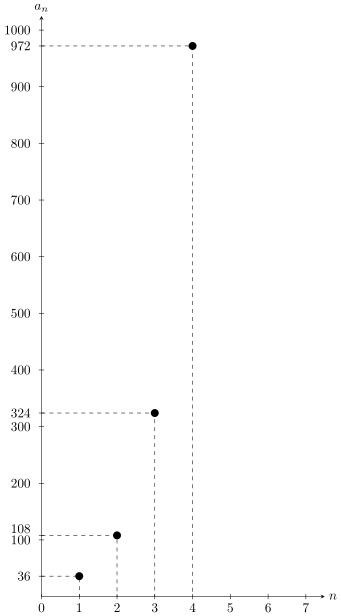
The picture shows a part of the graph of the geometric sequence. What is the explicit formula for the \(n\)th term of the following geometric sequence?
The picture shows a part of the graph of the geometric sequence. What is the explicit formula for the \(n\)th term of the following geometric sequence?