
Susan was asked to plot the graph of the function $h(x)=f(x)+g(x)$, where: $$ f(x)=\frac{x^2-5x+6}{x-3},~g(x)=\sin x-x $$ She performed algebraic operations to simplify the expression for $h(x)$ in the following way:
(1) She substituted the given expressions for functions $f$ and $g$:
$$ h(x)=f(x)+g(x)=\frac{x^2-5x+6}{x-3}+\sin x-x $$
(2) She factored the numerator of the fraction into a product: $$ \frac{x^2-5x+6}{x-3}=\frac{(x-3)(x-2)}{x-3} $$
(3) She cancelled the common factor $x-3$ in the fraction and further simplified the whole expression from the step (1): $$ \frac{x^2-5x+6}{x-3}+\sin x-x=x-2+\sin x-x=\sin x-2 $$
(4) Then, she plotted the graph of $h$:
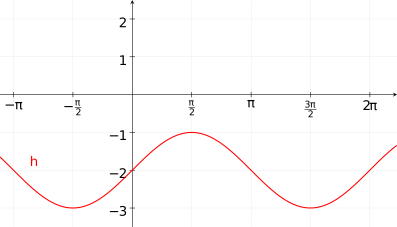
Is the graph of the function $h$ plotted correctly? Choose the correct answer.
No. The function $h$ is not defined for all real numbers.
No. There is an error is in step (2). It should be: $$ \frac{(x-3)(x+2)}{x-3} $$
No. It is not possible to create a new function by adding other functions.
Yes. The entire process and the graph are correct.
No. The graph of the function $h$ should be a hyperbola because the function $f$ is the rational function.
The function $h$, as well as the function $f$, is not defined at $x=3$, so the point with the coordinates $[3, \sin 3-2]$ must be excluded from the final graph.
