
There is a graph of a function $y=f(x)$ given.
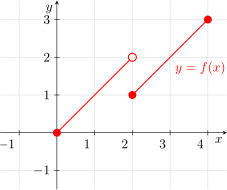
Find the incorrect statement:
(1) On the interval $[ 0,2)$, it is true that $f(x)=x$. Therefore, $f$ is increasing on $[ 0,2)$.
(2) On the interval $[ 2,4]$, it is true that $f(x)=x−1$. Therefore, $f$ is also increasing on $[ 2,4]$.
(3) Since $f$ is increasing on both intervals $[ 0,2)$ and $[ 2,4]$, $f$ is increasing also on $[ 0,2)\cup [ 2,4] =[ 0,4]$.
The mistake is in (1). The function $f(x)=x$ is not increasing on the interval $[ 0,2)$, it is only non-decreasing.
The mistake is in (2). The function $f(x)=x−1$ is not increasing on the interval $[ 2,4]$ since the constant term of this linear function is negative.
The mistake is in (3). On the interval $[ 0,4]$, which was formed by the union of intervals $[ 0,2)$ and $[ 2,4]$, we can only claim that the function $f$ is non-decreasing.
The mistake is in (3). If $f$ is increasing on $[ 0,2)$ and at the same time on $[ 2,4]$, it is impossible to make a general statement about the monotonicity of the function on $[ 0,4]$.
