
The graph of the quadratic function $$ f(x)=2x^2+4x-6 $$ is a parabola. Emil was tasked with determining the coordinates of its vertex $V=[v_1,v_2]$.
Emil proceeded as follows:
(1) He realized that for a quadratic function: $$ f(x)=ax^2+bx+c $$ there is a formula for the first coordinate of the vertex: $$ v_1=-\frac{b}{2a} $$ He substituted $a=2$, $b=4$ and so he obtained: $$ v_1=-\frac{4}{2\cdot 2}=-1 $$
(2) Emil calculated the second coordinate $v_2$ by substituting $v_1=-1$ for $x$ into the function’s equation: $$ v_2=f(v_1)=2v_1^2+4v_1-6=2(-1)^2+4(-1)-6=2-4-6=-8 $$
(3) He found that the coordinates of the vertex are: $$ V=[-1,-8] $$
Suzan disagreed with Emil. She objected against his procedure and insisted on hers:
(1) Suzan determined the intersections of the graph of the given quadratic function with the $x$-axis by solving the equation $f(x)=0$, which is $2x^2+4x-6=0$. Using the quadratic formula, she obtained: $$ x_{1,2}=\frac{-4\pm \sqrt{4^2-4\cdot 2\cdot (-6)}}{2\cdot 2}=\frac{-4\pm \sqrt{16+48}}{4}=\frac{-4\pm 8}{4} $$ and so: $$ x_1=\frac{-4+8}{4}=1,~ x_2=\frac{-4-8}{4}=-3 $$
Since a parabola is symmetric about the vertical axis passing through the vertex of the parabola, the coordinate $v_1$ is exactly the midpoint between the points $x_1=1$ and $x_2=-3$. From the diagram, it is clear that: $$ v_1=-1 $$
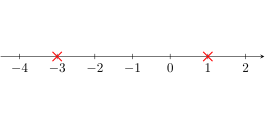
Suzan agreed that steps (2) and (3) of Emil’s procedure are correct and further proceeded identically. Thus, she also arrived at vertex coordinates: $$ V=[-1,-8] $$
Robert carefully observed their approaches and decided that the procedure could be simplified. He used the method of "completing the square."
(1) In the function’s equation: $$ f(x)=2x^2+4x-6 $$
he factored out the coefficient of the quadratic term from the quadratic and linear terms: $$ f(x)=2(x^2+2x)-6 $$
(2) He completed the quadratic binominal in the parentheses to a trinomial $x^2+2x+1$, so that it equals to the square of the binomial $x+1$, meaning: $$ x^2+2x+1= (x+1)^2 $$
He wrote the functions equation as:
$$ f(x)=2(x^2+2x+1-1)-6 $$
(adding and subtracting $1$ does not change the value of the expression).
(3) Finally, he simplified the equation to: $$ \begin{aligned} f(x)&=2(x+1)^2-2\cdot 1-6 \cr f(x)&=2(x+1)^2-8 \end{aligned} $$
(4) From this form of equation, Robert determined the coordinates of $V$: $$ V=[-1,-8] $$
Find the true statement:
The procedures of all three students are correct.
Only Suzan’s approach is correct.
Only Robert’s approach is correct.
Only Emil’s approach is correct.
The information given is not sufficient to find the coordinates of the vertex.
Robert and Emil applied the method, which is general for solving this problem. Suzan’s procedure is correct but cannot be applied if the corresponding quadratic equation $f(x)=0$ has no solution.
