Students were tasked with the following problem:
A pedestrian and a cyclist are moving towards an intersection along two straight forest paths that intersect perpendicularly. At time $t = 0$, the pedestrian is at the point $P_0$, which is $4\,\mathrm{km}$ away from the intersection $K$ (i.e., $ |P_0K| = 4$) and is moving at a constant speed of $v_1 = 5\,\mathrm{km/h}$. At the same time $t = 0$, the cyclist is at the point $C_0$, which is $6\,\mathrm{km}$ away from the intersection $K$ (i.e., $|C_0K| = 6$) and is moving at a constant speed of $v_2 =15\,\mathrm{km/h}$. At what time $t$ will they be closest to each other? To illustrate the situation, the teacher drew a diagram on the board, and students then presented their solutions:
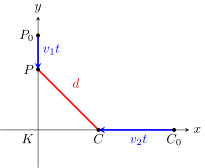
At time $t \geq 0$ the pedestrian is at the point $P$ at the distance $|PK|$ from the intersection $K$: $$ |PK| = \left||P_0K| - |P_0P|\right| = |4 - v_1t| = |4 - 5t|. $$ Similarly, at time $t \geq 0$, the cyclist is at the point $C$ at the distance $|CK|$ from the intersection $K$: $$ |CK| = \left||C_0K| - |C_0C|\right| = |6 - v_2t| = |6 - 15t|. $$
Alice: The distance $d$ between the pedestrian and the cyclist at the time $t$ can be expressed using the Pythagorean theorem as: $$ d(t)= \sqrt{(4 - 5t)^2 + (6 - 15t)^2} $$ The distance $d(t)$ will be minimized whenever the function: $$ f(t) = d^2(t) = (4 - 5t)^2 + (6 - 15t)^2 $$ reaches its minimum.
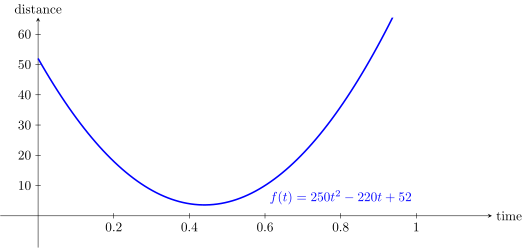
It is a quadratic function whose equation can be further simplified: $$ \begin{gather} f(t) = 16 - 40t + 25t^2 + 36 - 180t + 225t^2 \cr f(t) = 250t^2 - 220t + 52 \end{gather} $$ To find the minimum of this function, we use the formula for the first coordinate $t_V$ of the vertex of a parabola $f(t) = at^2+bt+c$: $$ t_V = - \frac{b}{2a} = \frac{220}{2 \cdot 250} = \frac{220}{500} = 0.44 $$
Alice’s answer: The distance between the cyclist and the pedestrian will be the shortest after $0.44$ hours, which is $26$ minutes and $24$ seconds.
Bob: The shortest distance between the pedestrian and cyclist occurs when the one closer to the intersection (the pedestrian) is right at the intersection (the shortest distance is not measured along the diagonal). The pedestrian reaches the intersection at time: $$ t = \frac{|P_0K|}{v_1}= \frac45 = 0.8 $$ Bob’s answer: The shortest distance between the pedestrian and the cyclist occurs after $0.8$ hours, which is $48$ minutes.
Cecilia: The shortest distance between the pedestrian and the cyclist occurs when the first of them (the cyclist) reaches the intersection (the distance is not measured along the diagonal). The cyclist reaches the intersection at time: $$ t = \frac{|C_0K|}{v_2}= \frac{6}{15} = 0.4 $$ Cecilia’s answer: The shortest distance between the pedestrian and the cyclist occurs after $0.4$ hours, which is $24$ minutes.
David: The distance between the pedestrian and cyclist is minimized when both reach the same distance from the intersection (the triangle $PKC$ is then isosceles, making its hypotenuse the shortest possible). This means: $$ \begin{aligned} 4 - 5t &= 6 - 15t \cr 10t &= 2 \cr t &= 0.2 \end{aligned} $$ David’s answer: The shortest distance between the pedestrian and the cyclist occurs after $0.2$ hours, which is $12$ minutes. Did any of the students solve the problem correctly?
Yes, Alice.
Yes, Bob.
Yes, Cecilia.
Yes, David.
Yes, all of them solved the problem correctly because, according to the Perpendicular Theorem, the distance between objects moving perpendicularly does not change.
Nobody.
The distance $d$ between the pedestrian and cyclist at time $t$, is given by the equation $$ d(t)= \sqrt{(4 - 5t)^2 + (6 - 15t)^2}. $$ Note that the minimum of a nonnegative function occurs at the same point as the minimum of the square of that function. For this reason, it is possible to minimize the function $d(t)$ by minimizing the function: $$ f(t) = (d(t))^2 = (4 - 5t)^2 + (6 - 15t)^2 = 250t^2 - 220t + 52 $$ whose graph is shown in the following figure.