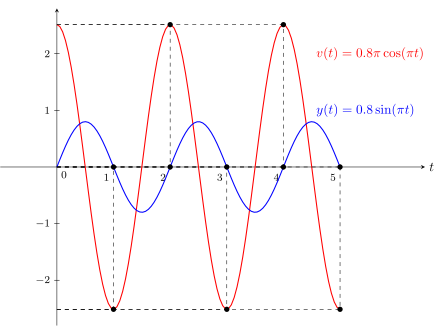
Bob was tasked with determining the maximum magnitude of velocity that a point mass can reach on a spring oscillating harmonically (along a straight line) in an environment without resistance. Its motion is described by the equation: $$ y(t)=0.8\sin (\pi t), $$ where $y(t)$ represents the deviation from the equilibrium position in meters and $t$ represents time in seconds.
First, Bob calculated the first derivative of $y$ with respect to time and got the equation for velocity at time $t$: $$ v(t)=y'(t)=0.8\cos (\pi t) $$
He realized that the cosine function takes on the maximum value of $+1$ (and minimum value of $-1$), so he concluded that the maximum velocity magnitude is $0.8\,\mathrm{m}\cdot \mathrm{s}^{-1}$.
Did Bob solve the task correctly? Explain.
No. He did not calculate the derivative $y'(t)$ correctly.
No. The velocity $v(t)$ is not equal to $y'(t)$.
Yes. The maximum velocity magnitude is calculated correctly.
No. The maximum velocity magnitude cannot be calculated from the given equation.
When taking the derivative of $y(t)$, Bob forgot to apply the chain rule and differentiate the inner function. The correct differentiation is: $$ v(t)=y'(t)=0.8\pi \cos (\pi t). $$ The maximum velocity magnitude is therefore $0.8\pi\,\mathrm{m}\cdot \mathrm{s}^{-1} \doteq 2.51\,\mathrm{m}\cdot \mathrm{s}^{-1}$.
The maximum velocity magnitude is reached at times $t\geq 0$ satisfying $\cos (\pi t)=1$ or $\cos (\pi t)=-1$. In these cases, the velocity magnitude is maximal but the velocity vector has the opposite direction. It is not difficult to verify that maximum velocity magnitude is reached at all times $t\in \mathbb{N} \cup {0}$ (see the graph in the picture below).