
Students were tasked with finding the local extrema of the function: $$f(t)=3t^4−4t^3,$$ where $t \in \mathbb{R}$.
All of them correctly found the first derivative: $$ f'(t)=12t^3−12t^2, $$ and set it equal to zero to find the critical points, obtaining the equation: $$ 12t^3−12t^2=0. $$ From this point, each student proceeded slightly differently.
Adam rewrote the equation as: $$ 12t^3=12t^2. $$ By dividing both sides by $t^2$, he obtained the equation $12t =12$, which has a single solution $t =1$. He then concluded that the only extremum of the function $f $ is at this point.
Bob factored the equation $12t^3−12t^2=0$ as: $$ 12t^2(t −1)=0 $$ and identified two solutions: $t_1=1$ and $t_2=0$. Bob then concluded that the function $f$ has local extrema at both these points.
David proceeded in a similar way to Bob, factoring the equation and obtaining two solutions, $t_1=1$ and $t_2=0$. To verify if these points are indeed extrema, he calculated the second derivative: $$ f''(t)=36t^2−24t $$ He substituted the critical points $t_1=1$ and $t_2=0$ into the second derivative: $$ f''(1)=36\cdot 1^2−24 \cdot 1=12>0 $$ which means that there is a local minimum at point $1$ and $$ f''(0)=36 \cdot 02−24 \cdot 0=0 $$
which means that there is no local extremum at point $0$.
Ema also found the two critical points $t_1=1$ and $t_2=0$ by factoring. She reasoned as follows:
Around $t_1=1$ the sign of the first derivative changes indicating that $f $ has a local extremum at point $1$. More precisely, on the interval $(0,1)$, the first derivative of $f$ is negative, and on the interval $(1,+\infty)$, it is positive. Because $f$ is continuous at point $1$, it holds that $f$ is decreasing on $[ 0,1 ]$ and it is increasing on $[ 1,+\infty)$. This means there is a local minimum at point $1$.
On the other hand, around $t_2=0$ the sign of the first derivative does not change, so $f$ does not have a local extremum at point $0$.
Which students did not make any mistakes?
Only Ema.
Adam, David and Ema.
David and Ema.
Only Bob.
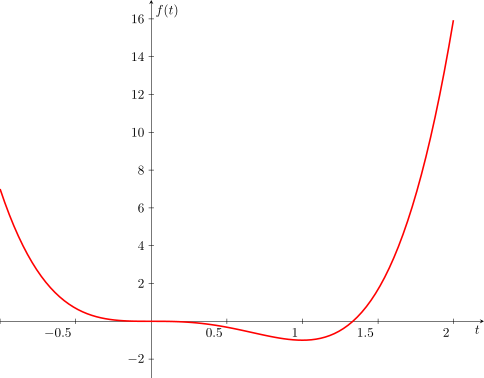
Adam lost one of the critical points by dividing the equation of the first derivative of the function $f$.
Bob incorrectly assumed that a local extremum automatically occurs at every critical point of the first derivative of the function $f$.
David should have realized that if both the first and the second derivatives are zero at a certain point, it is not possible to determine the presence of a local extremum based solely on these derivatives.
