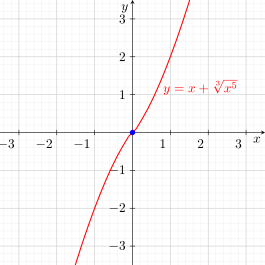
Alice was given the task to find inflection points on a graph of the function: $$ f(x)=x+\sqrt[3]{x^5},~\mathrm{where}~x\in \mathbb{R} $$ First, she found the first derivative of $f$: $$ f'(x)=1+\frac53 x^{\frac23}=1+\frac53 \sqrt[3]{x^2} $$ and also the second derivative of $f$: $$ f''(x)=\frac{10}9 x^{-\frac13}=\frac{10}{9\sqrt[3]x} $$ Then, she set the second derivative equal to zero, getting the equation: $$ \frac{10}{9\sqrt[3]x}=0 $$ which has no real solution. Based on this, she concluded that the graph of the function $f$ has no inflection points.
The teacher asked Alice's classmates to comment on her solution:
George says that to find inflection points, Alice should have set the first derivative equal to zero. The second derivative is not needed.
Sandra says that there is a mistake in the second derivative. The correct one should be $$f''(x)=1+\frac{10}9 x^{-\frac13}=1+\frac{10}{9\sqrt[3]x}$$
Monika says that the equation $\frac{10}{9\sqrt[3]x}=0$ results in $x=0$.
Eva says that she agrees with Alice that the equation $\frac{10}{9\sqrt[3]x}=0$ has no real solution. However, this fact cannot be used to make any conclusion about inflection points. If we check the first derivative, we shall see that it is positive for all real $x$. This implies that the given function is always increasing. Thus, such a function does not have an inflection point.
Decide which of the classmates is right.
George
Sandra
Monika
Eva
None of them
The equation $$f''(x)=\frac{10}{9\sqrt[3]x}$$ for the second derivative is defined for all values of $x$ except for $0$. The second derivative at $x=0$ does not exist. However, an inflection point can occur where the second derivative does not exist. Let's observe the following: The first derivative of the function f at $x=0$ is finite (specifically, it is equal to $1$). Moreover, it is not difficult to see that: $$ \begin{aligned} f''(x)&>0 \mathrm{~on~} (0,+\infty) \cr f''(x)&<0 \mathrm{~on~} (-\infty,0) \end{aligned} $$ From this, we can conclude that the function $f$ is strictly concave on $(-\infty,0)$ and strictly convex on $(0,+\infty)$. This means that there is an inflection point at $x=0$, so the point $[0;0]$ is the inflection point of the graph of the function $f$ (see the picture).