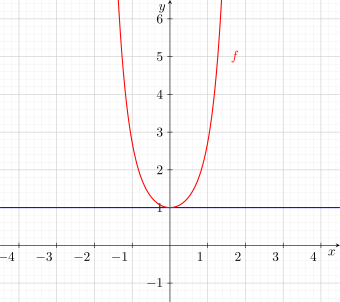
Adam was given the task to find the derivative of the function $$ f(x)=\mathrm{e}^{x^2} $$ at the point $x=0$. He proceeded as follows:
First, he realized that it was a composite function, where the inner function is the exponential function $y=e^x$ and the outer function is the quadratic function $y=x^2$.
He differentiated the function $f$ using the chain rule for differentiating composite functions: $$ f'(x)=2\cdot (\mathrm{e}^x )^1\cdot (\mathrm{e}^x )'=2\cdot \mathrm{e}^x\cdot \mathrm{e}^x=2\cdot (\mathrm{e}^x )^2 $$ Setting $x=0$ provided him with the value of the derivative at this point: $$ f'(0)=2\cdot (\mathrm{e}^0 )^2=2\cdot 1^2=2 $$ Is Adam’s procedure correct? Explain.
No. The inner and outer functions are incorrectly identified.
Yes. The procedure is correct.
No. The equality $2\cdot (\mathrm{e}^x )^1\cdot (\mathrm{e}^x )'=2\cdot \mathrm{e}^x\cdot \mathrm{e}^x$ is not true.
No. The derivative of the function $f$ is $f'(x)=\mathrm{e}^{x^2 }$, and it is true that $f'(0)=\mathrm{e}^0=1$.
The mistake is at the very beginning when Adam misunderstood the notation convention for exponents. Instead of $\mathrm{e}^{x^2}$, which means $\mathrm{e}^{(x^2 )}$, Adam used $(\mathrm{e}^x )^2$, which equals $\mathrm{e}^{2x}$.
The correct procedure is as follows: The inner function is the quadratic function $y=x^2$, and the outer function is the exponential function $y=\mathrm{e}^x$. For the derivative of the function $f(x)=\mathrm{e}^{x^2}$, it is true that: $$ f'(x)=\mathrm{e}^{x^2 }\cdot (x^2)'=\mathrm{e}^{x^2 }\cdot 2x=2x\cdot \mathrm{e}^{x^2 } $$ Setting $x=0$ provides us with the value of the derivative at this point: $$ f'(0)=2\cdot 0\cdot \mathrm{e}^{0^2}=0 $$ The figure of the graph of the function $f$ shows that the derivative at the point $x=0$ is indeed zero (the tangent is parallel to the $x$-axis).