
Paris solved a physics problem:
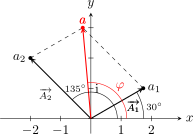
Determine the amplitude and initial phase of the oscillation resulting from the composition of two harmonic oscillations of the same frequency in the same direction. The first one has an amplitude of $A_1=2\,\mathrm{cm}$ and an initial phase of $\varphi_1=30^{\circ}$. The second oscillation has an amplitude of $A_2=2\sqrt2\,\mathrm{cm}$ and an initial phase of $\varphi_2=135^{\circ}$.
In which step of his solution did Paris make a mistake?
Solution:
(1) Paris plotted the phasors $\overrightarrow{A_1}$, $\overrightarrow{A_2}$ of the given oscillations in the Gauss plane. He also drew the phasor $\overrightarrow{A}$ of the composed oscillation. Then, he labeled the complex numbers corresponding to the endpoints of these phasors as $a_1$, $a_2$, and $a$.
(2) Further, Paris expressed $a_1$ and $a_2$ in polar form: \begin{aligned} a_1&=2\left(\cos30^{\circ}+\mathrm{i}\sin30^{\circ}\right)\cr a_2&=2\sqrt2\left(\cos135^{\circ}+\mathrm{i}\sin135^{\circ}\right)\cr \end{aligned} (3) Next, he converted $a_1$ and $a_2$ to their algebraic form and determined $a$ as the sum of them: \begin{aligned} a_1&=\sqrt3+\mathrm{i}\cr a_2&=-2+2\mathrm{i}\cr a=a_1+ a_2&=\sqrt3-2+3\mathrm{i} \end{aligned} (4) Then, Paris determined the absolute value: $$|a|=2\sqrt{4-\sqrt3}\doteq 3$$ (5) She found the argument of the complex number $a$: $$\sin\varphi=\frac{3}{2\sqrt{4-\sqrt3}}\Rightarrow \varphi\doteq 84^{\circ}54^{'}$$
(6) Finally, Paris wrote down the conclusion for the task: The amplitude of the composed oscillation is approximately $3\, \mathrm{cm}$ and the initial phase is approximately $84^{\circ}54^{'}$.
In step (2). The correct expression of $a_2$ is: $$a_2=2\sqrt2\left(\cos45^{\circ}+\mathrm{i} \sin 45^{\circ}\right)$$
In step (3). The correct algebraic forms of $a_1$ and $a_2$ and their sum are: \begin{aligned} a_1&=\sqrt3+\mathrm{i}\cr a_2&=2-2\mathrm{i}\cr a=a_1+ a_2&=\sqrt3+2-\mathrm{i} \end{aligned}
In step (4). The absolute value of $a$ is: $$|a|=\sqrt{\left(\sqrt{3}\right)^2+(-2)^2+3^2}=4$$
In step (5). The argument $\varphi$ of the complex number $a$ must be a solution to the system of the following equations.
$$\sin\varphi=\frac{3}{2\sqrt{4-\sqrt{3}}} \wedge \cos\varphi=\frac{\sqrt3-2}{2\sqrt{4-\sqrt3}}.$$
$$\varphi\doteq95^{\circ}6^{'}$$