B

1103134405

Level: 
B
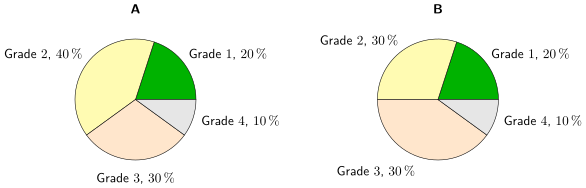
The students are evaluated according to the grading scale from \( 1 \) to \( 5 \), while \( 1 \) is the best grade and \( 5 \) is the worst one. In the pictures, there are visualizations of relative frequencies of grades in Math, which students of two groups (A and B) had in their year-class-reports. Calculate the variance of grades for each group of students and determine, in which group student performances of Math knowledge are more balanced. I.e. from the offered choices choose the group, which has more balanced grades and with the correct variance of grades. The variance is rounded to two decimal places.
A: \( 0{.}81 \)
B: \( 0{.}84 \)
A: \( 0{.}90 \)
B: \( 0{.}92 \)
1003134403

Level: 
B
The average age of town citizens decreased by \( 19\,\% \) due to a satellite town construction. The variance of the age has increased by \( 21\,\% \). Complete the correct statement. The coefficient of variation .... (Note: The results are rounded to two decimal places.)
increased by \( 35{.}80\,\% \).
increased by \( 49{.}38\,\% \).
decreased by \( 33{.}06\,\% \).
decreased by \( 26{.}36\,\% \).

1003134402

Level: 
B
There are two groups, A and B, of students in German language class. Each group consists of \( 15 \) students. In the tables, down each column, a student’s ID and grade from the mid-year’s grade report are listed. The students are evaluated according to the grading scale from \( 1 \) to \( 5 \), while \( 1 \) is the best grade and \( 5 \) is the worst one. Calculate the coefficient of variation of grades for each group and determine in which group the grades are more balanced. I.e. choose the name of the group with more balanced grades and with the correct coefficient of variation (\( \% \)) of grades. The value of the coefficient of variation is rounded to two decimal places. \[ \begin{array}{|c|c|c|c|c|c|c|c|c|}\hline \textbf{A -- students} & 1 & 2 & 3 & 4 & 5 & 6 & 7 & 8 \\\hline \textbf{Grade} & 2 & 2 & 2 & 2 & 3 & 2 & 1 & 2 \\\hline \\\hline \textbf{A -- students} & 9 & 10 & 11 & 12 & 13 & 14 & 15 & \\\hline \textbf{Grade} & 2 & 1 & 3 & 1 &3 & 2 & 3 & \\\hline \end{array} \] \[ \begin{array}{|c|c|c|c|c|c|c|c|c|}\hline \textbf{B -- students} & 1 & 2 & 3 & 4 & 5 & 6 & 7 & 8 \\\hline \textbf{Grade} & 2 & 1 & 1 & 2 & 2 & 3 & 1 & 2 \\\hline \\\hline \textbf{B -- students} & 9 & 10 & 11 & 12 & 13 & 14 & 15 & \\\hline \textbf{Grade} & 2 & 1 & 2 &1 &1 &1 &1 & \\\hline \end{array} \]
A: \( 32{.}90\,\% \)
A: \( 3{.}04\,\% \)
B: \( 40{.}32\,\% \)
B: \( 2{.}48\,\% \)

1003134401

Level: 
B
We want to compare the performances of two javelin throwers in one competition. Throws of Alex and Martin (in meters) are recorded in the following table. Calculate the coefficient of variation for each set of results and determine, which of the athletes has more balanced performance. I.e. choose the name of the athlete with more balanced performance and with the correct coefficient of variation (\( \% \)) of his throws. The coefficient of variation is rounded to two decimal places. \[ \begin{array}{|c|c|c|c|c|} \hline \textbf{Alex} & 78.95 & 83.32 & 86.14 & 84.46 \\\hline \textbf{Martin} & 84.66 & 83.63 & 76.83 & 83.23 \\\hline \end{array} \]
Alex: \( 3{.}20\,\% \)
Alex: \( 27{.}99\,\% \)
Martin: \( 4{.}52\,\% \)
Martin: \( 23{.}52\,\% \)

1003086008

Level: 
B
The solution set of the equation \( \mathrm{tg}\,x\cdot\mathrm{cotg}\,x = 1 \) for \( x\in\mathbb{R} \) is:
\( \mathbb{R}\setminus\left\{\frac{k\pi}2\colon k\in\mathbb{Z}\right\} \)
\( \mathbb{R} \)
\( \mathbb{R}\setminus\left\{k\pi\colon k\in\mathbb{Z}\right\} \)
\( \mathbb{R}\setminus\left\{2k\pi\colon k\in\mathbb{Z}\right\} \)