B

1003108310

Level: 
B
The graph of the quadratic function \( f \) has the vertex at the point \( [3, -1] \) and it passes through the point \( [ -1, 3] \). Find the function \( f \).
\( f(x)=\frac14x^2-\frac32x+\frac54 \)
\( f(x)=\frac14x^2+\frac32x+\frac54 \)
\( f(x)=-\frac14x^2+\frac32x-\frac{13}4 \)
\( f(x)=x^2+6x+8 \)

1003108309

Level: 
B
The graph of the quadratic function \( f \) intersects coordinate axes at the points \( [-3,0] \), \( [1,0] \), \( \left[0,\frac32\right] \). Find the function \( f \).
\( f(x)=-\frac12(x+1)^2+2 \)
\( f(x)=-\frac12(x+1)^2+\frac12 \)
\( f(x)=-\frac12(x-1)^2+2 \)
\( f(x)=\frac12(x-1)^2+2 \)

1003108308

Level: 
B
Which of the following information are insufficient to determine quadratic function uniquely?
two intersection points with the \( x \)-axis and \( x \)-coordinate of the vertex
two intersection points with the \( x \)-axis and \( y \)-coordinate of the vertex
two intersection points with the \( x \)-axis and any other point of the function
coordinates of the vertex and the intersection with the \( y \)-axis

1003108306

Level: 
B
The \( x \)-axis is the tangent line of the graph of the quadratic function \( f \). The point of tangency has the coordinates \( [-2,0] \). Given \( f(-1)=-4 \), find the function \( f \).
\( f(x)=-4x^2-16x-16 \)
\( f(x)=-4x^2-16x+16 \)
\( f(x)=-\frac49x^2+\frac{16}9x-\frac{16}9 \)
\( f(x)=4x^2-16x+16 \)

1003108303

Level: 
B
Maximum value of the quadratic function \( f \) is \( 2 \). The graph of \( f \) intersects the \( x \)-axis at the points \( [-1,0] \) and \( [3,0] \). Find the function \( f \).
\( f(x)=-\frac12x^2+x+\frac32 \)
\( f(x)=x^2-2x+3 \)
\( f(x)=x^2-2x-3 \)
\( f(x)=-\frac12x^2-x+\frac32 \)

1003108302

Level: 
B
The graph of the quadratic function \( f \) is a parabola with the vertex \( [2,5] \). The parabola intersects the \( y \)-axis at the point \( [0,3] \). Find the function \( f \).
\( f(x)=-\frac12(x-2)^2+5 \)
\( f(x)=-\frac12(x+2)^2+5 \)
\( f(x)=-2(x-2)^2+5 \)
\( f(x)=-2(x+2)^2+5 \)

1103148604

Level: 
B
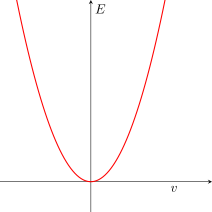
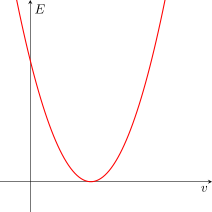
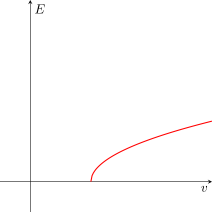
The total mechanical energy \( E \) of an object is given by the formula \( E=mgh+\frac12mv^2 \), where \( m \) is the mass of the object, \( g \) is the acceleration due to gravity (about \( 10\,\mathrm{m}/\mathrm{s}^2 \)), \( h \) is the height of the object above the ground and \( v \) is the velocity of that object. Suppose that an object of the fixed mass \( m \) moves horizontally in the constant height \( h \) above the ground. Choose the graph, which could represent the dependence between the total mechanical energy (\( E \)) and velocity (\( v \)) of the object.