9000003608 Level: BSolve the following equation. \[ \frac{2} {3}\cdot 9^{x+1} - 13\cdot 6^{x} + 24\cdot 4^{x-1} = 0 \]\(1,\ -1\)\(\frac{3} {2},\ \frac{2} {3}\)\(\frac{1} {2},\ -\frac{1} {2}\)\(\frac{3} {2},\ -\frac{3} {2}\)
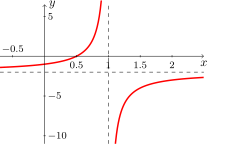
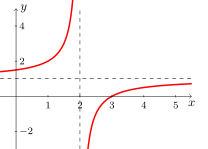
9000002905 Level: BFind the range of the function \(f(x)= \frac{1} {x-2} + 1\).\((-\infty ,1)\cup (1,\infty )\)\(\mathbb{R}\)\((-\infty ,2)\cup (2,\infty )\)\((-\infty ,-1)\cup (-1,\infty )\)
9000002901 Level: BFind the domain of the function \(f\colon y = \frac{1} {x-2} + 1\).\(\mathbb{R}\setminus \{2\}\)\(\mathbb{R}\setminus \{ - 1\}\)\(\mathbb{R}\setminus \{0\}\)\(\mathbb{R}\)
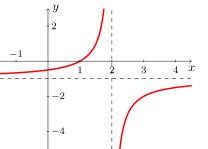
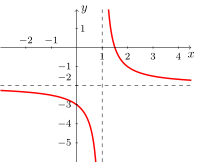
9000002906 Level: BFind the domain of the function \(f(x) = - \frac{3} {x-1} - 2\) if we have to ensure that the range of \(f\) is \((-1,1] \).\((-2,0] \)\([ - 2,0)\)\((0,2] \)\((0,4)\)
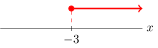
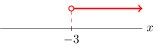
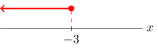
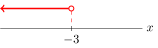
9100018108 Level: BGraph the solution of the following inequality. \[ \frac{x - 5} {2} \leq 2\left (x + 1\right ) \]
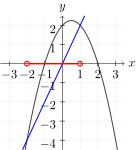
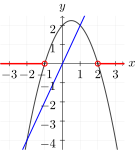
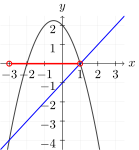
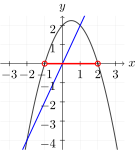
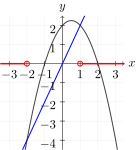
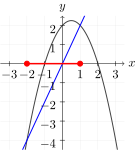
9100033706 Level: BIdentify a picture which shows graphical solution of the following quadratic inequality, assuming that the solution is the red set. \[ -x^{2} + x + 2 > 2x \]
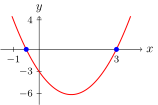
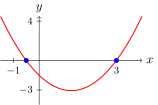
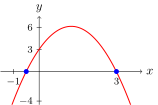
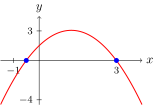
9100025608 Level: BIdentify the picture which shows solution of \[ \text{$2x^{2} - 5x - 3 = 0$} \] by a graphical method.