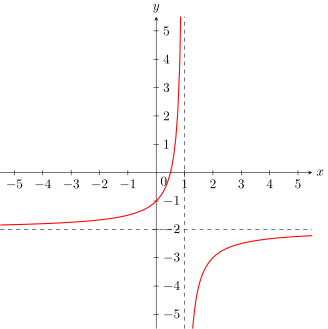
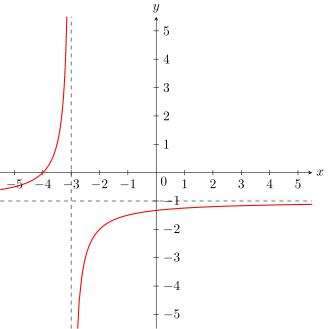
Let by \(X\) and \(Y\) denote the intersection points of the graph of the function \(f(x)=\frac{2}{x+3}-1\) with \(x\) and \(y\)-axis, respectively. Find coordinates of \(X\) and \(Y\).
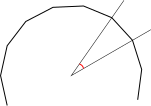
Consider a regular polygon with the central angle of \(15^{\circ}\). In the figure the cut of a regular polygon with unspecified number of vertices is shown. The red angle is the central angle of the polygon. Find the number of vertices of this polygon.
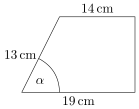
The figure shows a rectangular trapezium whose bases have lengths of \( 19\,\mathrm{cm} \) and \( 14\,\mathrm{cm} \), and the longer arm is \( 13\,\mathrm{cm} \) long. Calculate the sine of angle \(\alpha\).
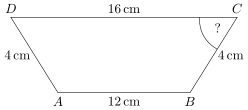
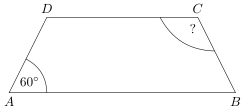
The isosceles trapezium \( ABCD \) is in the picture. The measure of the angle \( DAB \) is \( 60^{\circ} \). Determine the measure of the angle \( BCD \).
Identify the optimal first step convenient to solve the following trigonometric
equation. Do not consider the step which is possible but does not help to solve the
equation.
\[
\mathop{\mathrm{tg}}^2\nolimits x - 2\mathop{\mathrm{tg}}\nolimits x -3=0
\]
substitution \( \mathop{\mathrm{tg}}\nolimits x =y\)
\(\mathop{\mathrm{tg}}\nolimits x (\mathop{\mathrm{tg}}\nolimits x -2)=3\)