
Two students performed repeated measurements of the same length. After
evaluating statistical characteristics they got equal means of the length. Which of the
following statement is true? (Remark: The accuracy is determined by the coefficient of variation.)
There is not enough information to compare the accuracy of both measurements.
One of the students measured with a better accuracy than the other.
Both students did their measurements with the same accuracy.
Given points \(A = [-1;4]\),
\(B = [2,-2]\) and
\(C = [5,-1]\), find the angle
\(\beta \) (the interior angle
at the vertex \(B\))
in the triangle \(ABC\).
Two students performed repeated measurements of the same length. After
evaluating statistical characteristics they got equal standard deviations. Which of the
following statement is true? (Remark: The accuracy is determined by the coefficient of variation.)
There is not enough information to compare the accuracy of both measurements.
One of the students measured with a better accuracy than the other.
Both students did their measurements with the same accuracy.
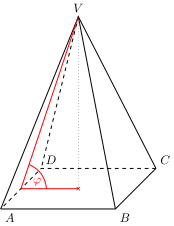
The picture shows a square pyramid. The side of a base square is
\(a = 4\; \mathrm{cm}\) and the height of
the pyramid is \(v = 6\; \mathrm{cm}\).
Find the angle \(\varphi \).
Two students performed repeated measurements of the same length. After
evaluating statistical characteristics they got equal means and also equal standard
deviations. Which of the following statement is true? (Remark: The accuracy is determined by the coefficient of variation.)
Both students did their measurements with the same accuracy.
There is not enough information to compare the accuracy of both measurements.
One of the students measured with a better accuracy than the other.
The stated question is irrelevant, two different statistical files cannot share their
means and their standard deviations.
Student did repeated measurements of the coefficient of friction,
which is a dimensionless quantity. The mean of the measurements is
\(0.6\) and the coefficient of
variation (relative error) \(10\%\).
From statistics it is known that with a probability nearly
\(100\%\) the
value of the coefficient is in the interval centered at the mean and having radius equal
to the triple of the standard deviation. Find the upper bound of this interval.