B

1103054911

Level: 
B
The lengths of sides of the parallelogram \( ABCD \) are \( 8\,\mathrm{cm} \) and \( 6\,\mathrm{cm} \). The size of one of its interior angles is \( 60^{\circ} \). Calculate the area of the parallelogram.
\( 24\sqrt3\,\mathrm{cm}^2 \)
\( 12\sqrt3\,\mathrm{cm}^2 \)
\( 24\,\mathrm{cm}^2 \)
\( 12\,\mathrm{cm}^2 \)

1103054906

Level: 
B
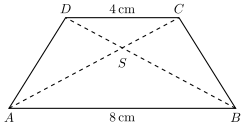
\( ABCD \) is a trapezium with bases \( |AB| = 8\,\mathrm{cm} \) and \( |CD| = 4\,\mathrm{cm} \). Calculate the area of the triangle \( ABS \) if the area of the triangle \( CDS \) is \( 12\,\mathrm{cm}^2 \), where \( S \) is the intersection point of the diagonals \( BD \) and \( AC \).
\( 48\,\mathrm{cm}^2 \)
\( 24\,\mathrm{cm}^2 \)
\( 6\,\mathrm{cm}^2 \)
\( 3\,\mathrm{cm}^2 \)
1103054902

Level: 
B
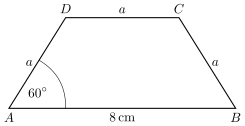
Let \( ABCD \) be a trapezium with the base $AB$ of \( 8\,\mathrm{cm} \). The remaining sides have the same length. The measure of \( \measuredangle DAB \) is \( 60^{\circ} \). Calculate the perimeter of the trapezium.
\( 20\,\mathrm{cm} \)
\( 4\,\mathrm{cm} \)
\( 14\,\mathrm{cm} \)
\( 24\,\mathrm{cm} \)

1103054901

Level: 
B
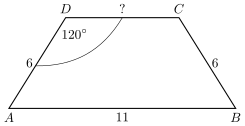
In an isosceles trapezium \( ABCD \) let \( |AB| = 11\,\mathrm{cm} \), \( |BC| = |AD| = 6\,\mathrm{cm} \) and the measure of the angle \( CDA \) be \( 120^{\circ} \). Calculate the length of the side \( CD \).
\( 5\,\mathrm{cm} \)
\( 8\,\mathrm{cm} \)
\( 3\,\mathrm{cm} \)
\( 7\,\mathrm{cm} \)

1003030308

Level: 
B
Let \( k_1 \) and \( k_2 \) be circles with the centres \( S_1 \), \( S_2 \), and the radii of lengths \( 5\,\mathrm{cm} \) and \( 1\,\mathrm{cm} \) consecutively. Given \(S_1=S_2\), what is the mutual position of these circles?
The circles \( k_1 \) and \( k_2 \) are concentric.
The circles \( k_1 \) and \( k_2 \) intersect.
The circle \( k_1 \) lies inside the circle \( k_2 \).
The circle \( k_2 \) lies outside the circle \( k_1 \).
The circles \( k_1 \) and \( k_2 \) are internally tangent.

1003030307

Level: 
B
Let \( k_1 \) and \( k_2 \) be circles with the centres \( S_1 \), \( S_2 \), and the radii of lengths \( 5\,\mathrm{cm} \) and \( 1\,\mathrm{cm} \) consecutively. Given \( |S_1S_2|=5\,\mathrm{cm} \), what is the mutual position of these circles?
The circles \( k_1 \) and \( k_2 \) intersect.
The circles \( k_1 \) and \( k_2 \) are internally tangent.
The circles \( k_1 \) and \( k_2 \) are externally tangent.
The circle \( k_1 \) lies inside the circle \( k_2 \).
The circle \( k_2 \) lies inside the circle \( k_1 \).

1003030306

Level: 
B
Let \( k_1 \) and \( k_2 \) be circles with the centres \( S_1 \), \( S_2 \), and the radii of lengths \( 5\,\mathrm{cm} \) and \( 1\,\mathrm{cm} \) consecutively. Given \( |S_1S_2|=4\,\mathrm{cm}\), what is the mutual position of these circles?
The circles \( k_1 \) and \( k_2 \) are internally tangent.
The circles \( k_1 \) and \( k_2 \) are externally tangent.
The circle \( k_1 \) lies inside the circle \( k_2 \).
The circle \( k_2 \) lies inside the circle \( k_1 \).