1003076507 Level: BFor which \( x \in[0,\frac{\pi}2] \) is \( \sin x = \cos x \)?\( \frac{\pi}4 \)\( 0 \)\( \frac{\pi}2 \)\( \frac{\pi}3 \)
1003076506 Level: BFind the smallest period of the function \( f(x)=\mathrm{tg}\,4x \):\( \frac{\pi}4 \)\( 4\pi \)\( \pi \)\( 2\pi \)
1003076505 Level: BChoose the false statement:\( \cos190^{\circ} > \cos240^{\circ} \)\( \sin140^{\circ} >\sin190^{\circ} \)\( \sin15^{\circ}>\sin210^{\circ} \)\( \cos305^{\circ}>\cos300^{\circ} \)
1003076504 Level: BChoose the false statement:The function \( f(x)= \mathrm{tg}\,x \) is even.The function \( f(x)=\mathrm{cotg}\,x \) is decreasing on the interval \( (0,\pi) \).The function \( f(x)=\sin x \) is bounded on its domain.The values of function \( f(x)=\cos x \) always lie between \( -1 \) and \( 1 \).
1003076503 Level: BChoose the true statement that applies to each of the functions \( f(x)=\sin x \), \( g(x)=\cos x \), \( h(x)= \mathrm{tg}\,x \):The function has infinitely many zero points.The function is odd.The function is bounded.The function is simple.
1003076502 Level: BTo which quadrant does the angle \( \alpha \) belong if \( \sin\alpha< 0 \) and \( \cos\alpha < 0 \)?III.I.II.IV.
1003076501 Level: BTo which quadrant does the angle \( \alpha \) belong if \( \sin\alpha=0.8 \) and \( \cos\alpha < 0 \)?II.I.III.IV.
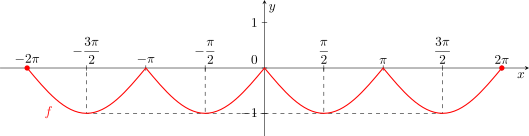
1103082703 Level: CFunction \( f \) is given completely by the next graph. Identify which of the following statements is true.\( f(x)=-|\sin x|,\ x\in[-2\pi,2\pi] \)\( f(x)=|\cos x|,\ x\in[-2\pi,2\pi] \)\( f(x)=|-\sin x|,\ x\in[-2\pi,2\pi] \)\( f(x)=-0.5\cdot\sin x,\ x\in[-2\pi,2\pi] \)
1003048506 Level: BIdentify which of the following functions has the smallest period.\( f(x)=(\cos(2x) )^2 \)\( h(x)=\sin\bigl(\frac{x}{2}\bigr) \)\( m(x)=\mathrm{tg}\,\bigl(\frac{x}{2}\bigr) \)\( g(x)=(\mathrm{cotg}\, x)^2 \)
9000038910 Level: BConsider the function \(f\colon y =\mathop{\mathrm{cotg}}\nolimits x\). In the following list identify the function which has the same graph as the graph of the function \(f\).\(k\colon y = -\mathop{\mathrm{tg}}\nolimits \left (x + \frac{\pi } {2}\right )\)\(g\colon y = -\mathop{\mathrm{tg}}\nolimits x\)\(b\colon y =\mathop{\mathrm{tg}}\nolimits \left (x + \frac{\pi } {2}\right )\)\(h\colon y =\mathop{\mathrm{tg}}\nolimits \left (x - \frac{\pi } {2}\right )\)\(m\colon y = -\mathop{\mathrm{tg}}\nolimits x - \frac{\pi } {2}\)