
Michael knows that the graphs of the tangent and cotangent functions are somehow related, but he does not remember exactly how and tries to figure it out. He starts with the observation that the graph of the cotangent function can be obtained by shifting and reflecting the graph of the tangent function.
Note: Michael is aware that both the tangent and cotangent functions are periodic, meaning, that only parts of their graphs can be drawn within a limited space. To simplify the explanation of his procedure, he refers to these parts as "graphs of these functions".
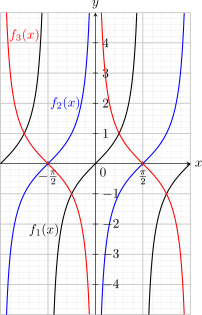
Michael's solution (see the picture):
(1) Michael first sketched the graph of the function: $$f_1(x)=\tan x$$
(2) He then shifted the graph of $f_1$ in the negative direction along the $x$-axis by $\frac{\pi}{2}$, obtaining the graph of the function: $$f_2(x)=\tan\left(x+\frac{\pi}{2}\right)$$
(3) Next, he reflected the graph of $f_2$ across the $x$-axis to obtain the graph of the function: $$f_3(x)=-\tan\left(x+\frac{\pi}{2}\right)$$
(4) Michael claimed that the graph of $f_3$ matches the graph of the function cotangent, for all $x$ in its domain. Based on his reasoning, he concluded that: $$-\tan\left(x+\frac{\pi}{2}\right)=\cot x$$
Is Michael's solution correct? If not, decide in which step Michal made a mistake.
Michael did not make a mistake. His solution is correct.
Michael made a mistake in step (1). The graph of the function $f_1$ is a curve of a different shape.
Michael made a mistake in step (2). If the graph of $f_2$ is obtained by shifting the graph of $f_1$ in negative direction along the $x$-axis by $\frac{\pi}{2}$, then: $$f_2(x)=f_1\left(x-\frac{\pi}{2}\right)=\tan\left(x-\frac{\pi}{2}\right)$$
Michael made a mistake in step (3). If the graph of $f_3$ is obtained by reflecting the graph of $f_2$ across the $x$-axis, then $f_3$ is given by: $$f_3(x)=f_2(-x)=\tan\left(-x-\frac{\pi}{2}\right)$$
Michael made a mistake in step (4). The graph of the function cotangent does not match the graph of $f_3$.
