
Given the points $K=[1; -4]$, $L=[2; -1]$, and $N=[-3; -2]$, calculate the area of the parallelogram $KLMN$ using the cross product of suitably selected vectors.
Rebecca solved this task in the following steps:
(1) She sketched a parallelogram $KLMN$. Then, she placed vectors $\,\overrightarrow{u}$ and $\,\overrightarrow{v}$ on its sides and calculated their coordinates (see the picture):
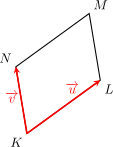
\begin{aligned} \overrightarrow{u}&=\overrightarrow{KL}= L - K = (1; 3)\cr \overrightarrow{v}&=\overrightarrow{KN}= N - K = (-4; 2) \end{aligned}
(2) According to the assignment, she calculated the cross product of the vectors $\,\overrightarrow{u}$ and $\,\overrightarrow{v}$, because she also knew from math classes that the area of a parallelogram can be calculated as the absolute value of the cross product of vectors located on its sides: \begin{array}{ccc} 3 & 1 &3\cr 2 &-4 &2\cr \hline \end{array}
\begin{aligned}
\overrightarrow{u}\times\overrightarrow{v}\,&=\left(3\cdot(-4) - 2\cdot1; 1\cdot2 - (-4)\cdot3\right)\cr
\overrightarrow{u}\times\overrightarrow{v}\,&=(-12 - 2; 2 + 12)\cr
\overrightarrow{u}\times\overrightarrow{v}\,&= (-14; 14)
\end{aligned}
(3) She then calculated the absolute value of the vector $(-14; 14)$: $$\left|(-14; 14)\right|=\sqrt{(-14)^2+14^2}=\sqrt{196+196}= \sqrt{196\cdot2}=14\sqrt2$$ (4) Finally, she answered that the area of the parallelogram $KLMN$ is $14\sqrt2$ square units.
Is there a mistake in Rebecca's solution? If yes, find where.
No. All the procedure is correct.
Yes. The mistake is in step (1). She incorrectly calculated the coordinates of one of the vectors.
Yes. The mistake is in step (2). She incorrectly calculated the cross product of vectors $\,\overrightarrow{u}$ and $\,\overrightarrow{v}$.
Yes. The mistake is in step (3). She incorrectly calculated the absolute value of the cross product.
Rebecca tried to determine the cross product for vectors defined in a plane, but she did not realize that the cross product is defined only for vectors in the space.
If we want to calculate the area of a parallelogram using the cross product, we need to place the parallelogram in space. We do this by adding a third coordinate of the same value to the coordinates of all its vertices (most often we choose a third coordinate equal to zero). Let us show the correct procedure:
(1) $K=[1; -4; 0]$, $L=[2; -1; 0]$, $N=[-3; -2; 0]$
(2) \begin{aligned} &\overrightarrow{u}=\overrightarrow{KL}= L - K = (1; 3; 0)\cr &\overrightarrow{v}=\overrightarrow{KN}= N - K = (-4; 2; 0)\cr &\overrightarrow{u}\times\overrightarrow{v}:\cr &\qquad\qquad\begin{array}{cccc} 3 &0 &1 &3\cr 2 &0 &-4 &2\cr \hline \end{array}\cr &\overrightarrow{u}\times\overrightarrow{v}=(3\cdot0 - 2\cdot0; 0\cdot(-4) - 0\cdot1; 1\cdot2 - (-4)\cdot3) = (0 - 0; 0 - 0; 2 + 12) = (0; 0; 14) \end{aligned}
(3) $$A_{KLMN} =|\,\overrightarrow{u}\times\overrightarrow{v}\,|=\left|(0; 0; 14)\right|= \sqrt{0^2+0^2+14^2}=\sqrt{196} = 14 \textbf{ square units}.$$
Do you know why the area of a parallelogram can be determined by the formula $\mathbf{A_{KLMN}=|\,\overrightarrow{u}\times\overrightarrow{v}\,|}$?
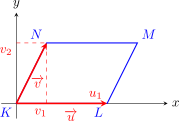
Let’s place the parallelogram in the coordinate system so that it lies in $xy$ plane (see the picture).
 \begin{aligned}
&\overrightarrow{u}=\overrightarrow{KL}= (u_1; 0; 0)\cr
&\overrightarrow{v}=\overrightarrow{KN}= (v_1; v_2; 0)\cr
&\overrightarrow{u}\times\overrightarrow{v}:\cr
&\qquad\begin{array}{cccc}
0 &0 &u_1 &0\cr
v_2 &0 &v_1 &v_2\cr
\hline
\end{array}\cr
&\qquad\overrightarrow{u}\times\overrightarrow{v}=(0\cdot0 - 0\cdot v_2; 0\cdot v_1 - u_1\cdot 0; u_1\cdot v_2 - 0\cdot v_1)\cr
&\qquad\overrightarrow{u}\times\overrightarrow{v}= (0; 0; u_1\cdot v_2)\cr
&|\,\overrightarrow{u}\times\overrightarrow{v}\,|= (0; 0; u_1\cdot v_2) =\sqrt{0^2+0^2+(u_1\cdot v_2)^2}=|u_1\cdot v_2 |,
\end{aligned}
where $u_1$ is the length of the side $\,\overrightarrow{u}$ of the parallelogram and $v_2$ is the size of the height to side $\,\overrightarrow{u}$ of the parallelogram. So
\begin{aligned}
&\overrightarrow{u}=\overrightarrow{KL}= (u_1; 0; 0)\cr
&\overrightarrow{v}=\overrightarrow{KN}= (v_1; v_2; 0)\cr
&\overrightarrow{u}\times\overrightarrow{v}:\cr
&\qquad\begin{array}{cccc}
0 &0 &u_1 &0\cr
v_2 &0 &v_1 &v_2\cr
\hline
\end{array}\cr
&\qquad\overrightarrow{u}\times\overrightarrow{v}=(0\cdot0 - 0\cdot v_2; 0\cdot v_1 - u_1\cdot 0; u_1\cdot v_2 - 0\cdot v_1)\cr
&\qquad\overrightarrow{u}\times\overrightarrow{v}= (0; 0; u_1\cdot v_2)\cr
&|\,\overrightarrow{u}\times\overrightarrow{v}\,|= (0; 0; u_1\cdot v_2) =\sqrt{0^2+0^2+(u_1\cdot v_2)^2}=|u_1\cdot v_2 |,
\end{aligned}
where $u_1$ is the length of the side $\,\overrightarrow{u}$ of the parallelogram and $v_2$ is the size of the height to side $\,\overrightarrow{u}$ of the parallelogram. So
$$|\,\overrightarrow{u}\times\overrightarrow{v}\,|=|u_1\cdot v_2 |= \mathbf{A_{KLMN}}.$$

