
David was tasked with calculating the following limit: $$ \lim_{x \rightarrow 0} \ln x $$
From his math lessons, he remembered the procedure of solving when we substitute for $x$ a number very close to the point at which we are trying to find the limit.
First, David sketched the graph of the function $y = \ln x$:
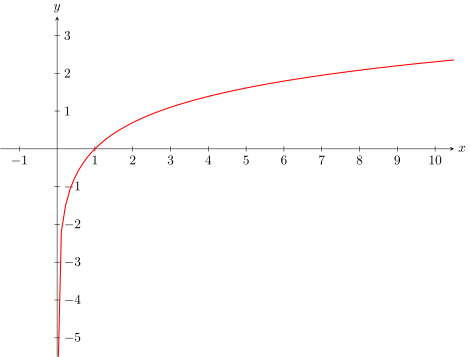
From the graph, he observed that as $x$ approaches $0$, the function values decrease below all bounds. He therefore concluded that: $$ \lim_{x \rightarrow 0} \ln x = -\infty $$
Did David find the limit correctly? Explain.
No. The limit of the function $y = \ln x$ at the point $x = 0$ does not exist.
Yes. The limit is determined correctly.
No. The limit of the function $y=\ln x$ at the point $x=0$ can be calculated as the function value at the point $0$, i.e., the correct result of our limit is $1$.
No. The graph is not correct. If we were to draw the correct graph, we would see that the limit of the function $y=\ln x$ at the point $x=0$ is equal to $+\infty$.
The function $y = \ln x$ at the point $x = 0$ does not have a limit. The limit from the right is $−\infty$, but the limit from the left does not exist (the logarithm is not defined for negative $x$ at all), and therefore there is no two-sided limit.
