
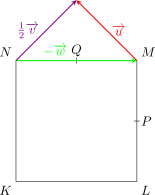
In the square $KLMN$, point $P$ is given at the center of side $LM$, and point $Q$ is given at the center of side $MN$. Express the vector $\overrightarrow{u}=\overrightarrow{PQ}$ as a linear combination of the vectors $\overrightarrow{v}=\overrightarrow{KM}$ and $\overrightarrow{w}= \overrightarrow{LK}$.
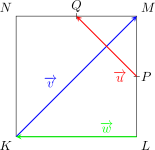
John attempted to solve the problem in the following steps:
(1) He placed the vectors $\,\overrightarrow{v}\,$ and $-\overrightarrow{w}\,$ so that their initial points were at point $N$.
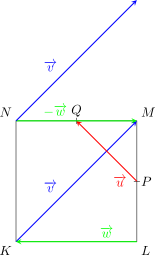
(2) He placed the vector $\,\overrightarrow{u}\,$ so that its initial point was at point $M$.
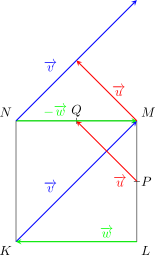
(3) He found that the vector $\,\overrightarrow{u}\,$ now connects the endpoints of vectors $\frac12\, \overrightarrow{v}$ and $-\overrightarrow{w}\,$ placed so that their initial points are at point $N$.
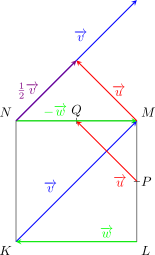
(4) He knew that the vector that connects the endpoints of two vectors is their difference, so he finally wrote: $\ \overrightarrow{u} = \frac12\, \overrightarrow{v}\ –\ \overrightarrow{w}$.
Is John's solution correct? If not, identify where John made a mistake.
John's solution is correct.
The mistake is in the step (1). The vector $-\overrightarrow{w}$ is not correctly positioned in the figure.
The mistake is in the step (3). The vector shown in purple is not the correct location of the vector $\frac12\, \overrightarrow{v}$.
The mistake is in the step (4). The vector that connects the endpoints of two vectors is their difference, and therefore: $$\overrightarrow{u}=\frac12\, \overrightarrow{v}-\left(-\overrightarrow{w}\, \right)=\frac12\, \overrightarrow{v}+\overrightarrow{w}. $$




